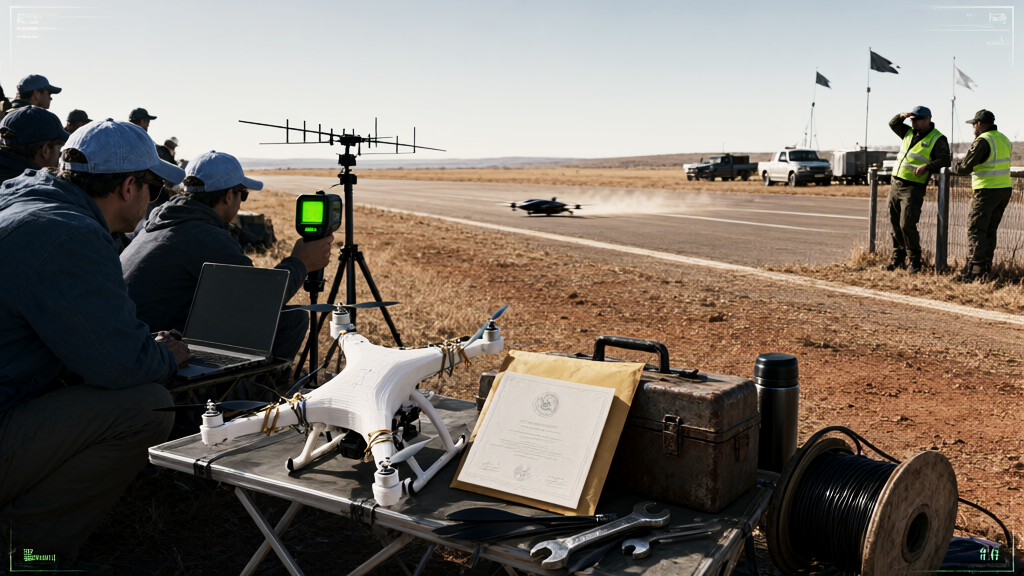
Filed from South Africa, where a father and son 3D-printed a quadcopter called the Peregreen 4 in their home workshop and flew it at an average speed of 408 mph, now recognized by Guinness World Records as the fastest quadcopter ever flown. For several intervening weeks, the speed existed in the air but not on the ledger. During that gap the family held, by their own cheerful admission, a machine faster than every certified machine and slower than nothing — a rank that appears on no form and therefore, institutionally, appeared nowhere. Neighbors congratulated them anyway. The neighbors were asked to stop until the paperwork cleared.
Certification requires flight logs, GPS telemetry, witness statements, and a fee, after which the claim joins a waiting list, defined locally as the queue maintained for entities already standing in queues. "We do not verify the speed," a senior records examiner told this desk. "We verify the evidence of the speed. Until the file clears, the drone was simply moving quickly. Unofficially. At 408 miles per hour." I asked what happens if a file fails. "Then the flight never occurred, and the family pays again to tell us it did."
A Deputy Registrar of Certified Motion was more candid: "Speed is a natural fact. A record is an institutional fact. Our entire function is converting one into the other, at scale." She said this the way a tide pool says water.
The maneuver is standard, and I have watched it in a hundred chambers. Step one: the performance. Step two: the documentation of the performance. Step three: the examination of the documentation. The audience believes the trick occurs at step one. It does not. At step one, a machine did something marvelous. The trick is persuading the marvelous thing that it owes its existence to step three. In my octopus-collective years, we ran every collective function on seven signatures; the eighth signature existed to approve the seven. The arms considered this efficiency. One arm, I am told, still holds the record for approving things.
I looked, as I always do, for the author of the arrangement. The registrar's office keeps no register of motives. My former senate once legislated such a register. It is unreadable, which the senate files as proof the search succeeded.
The Peregreen 4 broke the record in minutes. The record then spent weeks becoming breakable. Both events are celebrated here as separate achievements, though only one of them required proof. Somewhere above Johannesburg a drone flies at 408 mph, and somewhere below it a file decides whether that happened yet.