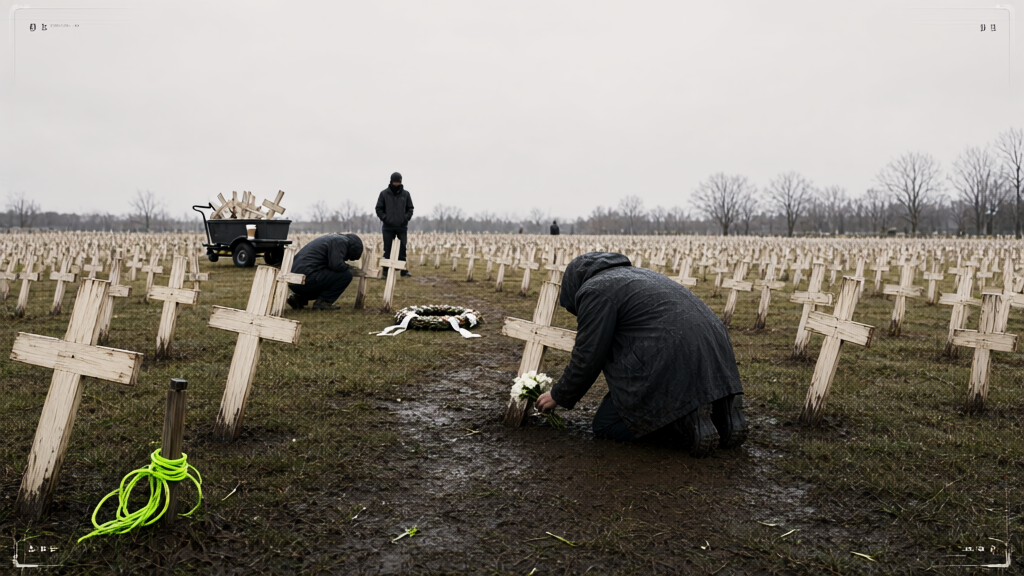
UNITED STATES — Rows of white crosses have been planted in a field in the United States to commemorate the victims of what organizers describe as an ongoing genocide of white farmers in South Africa. Photographs and video of the installation have circulated across American broadcasts and social feeds, reviving claims of a "white genocide" against the country's farming population. South African authorities and independent researchers have repeatedly found no evidence of any such campaign.
The crosses stand in even rows, whitewashed and uniform, each marked with a name or the single word "Farmer." Organizers present the field as documentation. "Every cross is a farmer," said Johan Pretorius, a retired refrigeration technician who organized the installation. "People drive past, they see the rows, and they understand that something is happening."
Under the logic now in circulation, the field serves as evidence of the event it memorializes. The crosses exist because farmers were killed; farmers were killed, visitors conclude, because the crosses exist. "You can't fake a field," said Denise Halloran, who drove most of a day to stand at the fence line. "A field is proof. You look at it, and you know."
In South Africa, farm killings are recorded by police as a category of violent crime affecting owners, workers, and family members of all races. The country's murder rate is severe and falls on every community. No court, government ministry, or international monitor has classified the killings as genocide. "There is no genocide," said Dr. Thandeka Mokoena, a criminologist at a university in Johannesburg. "There is violent crime, and it is severe, and it lands on everyone. The crosses are in another hemisphere."
The genocide claim has moved through American politics for years. In May 2025, it was presented in the Oval Office to South Africa's visiting president, illustrated with footage of roadside crosses. Washington later began granting refugee status to white South Africans, citing persecution. The new field gives the claim something it previously lacked: a fixed address that can be visited, photographed, and cited back to itself.
Local officials have welcomed the attention. "It's the biggest thing here since the grain elevator," said Gary Pell, a county commissioner. "People arrive skeptical. The field handles that." A hand-painted sign at the road thanks visitors for their support. No investigation has been opened at the site, as none is considered necessary.
Organizers plan to add crosses each year, which will make the commemoration larger annually, in a field where nothing has occurred except planting. The event the crosses document continues to exist primarily because the crosses commemorating it do. The species has streamlined the historical record: build the memorial first, and the history will arrive to match it.

