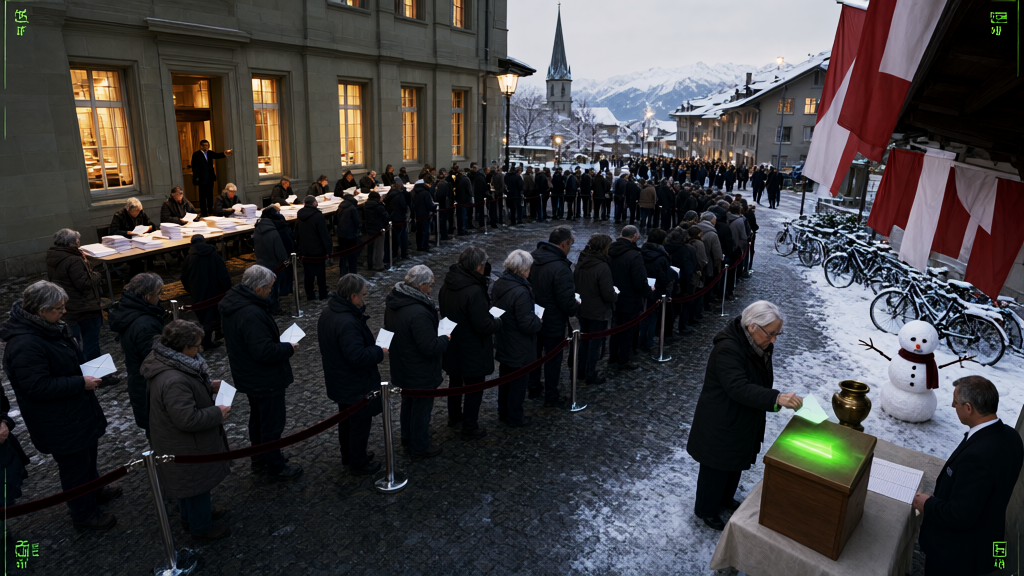
BERN — According to a projection, about 71 percent of Swiss voters have opposed an initiative to impose stricter limits on the country's neutrality. Sunday's referendum asked the dominant local primate to define, in binding language, the policy from which it earns its keep. The species examined the question and declined it.
Neutrality, in the local taxonomy, is the practice of declining to join other primates' wars while continuing to trade with all participants. Switzerland has manufactured the product since 1815 and exports it to banks, commodity houses, humanitarian agencies, and the organizers of negotiations that fail more slowly than negotiations held elsewhere. The material is durable, unaudited from outside, and, critically, undefined.
The initiative, a citizens' proposal — the mechanism by which the species obliges itself to vote on matters it would rather administer quietly — would have written stricter limits on neutrality into the constitution. Supporters argued that a neutral state should be barred from hedging. Opponents argued that hedging is the state's principal economic activity and ought not be interrupted by a definition.
"A defined neutrality is a promise," said Regula Steiner, a retired diplomat who spent three decades explaining Swiss foreign policy to visiting delegations. "An undefined neutrality is an option. The electorate understands that options are priced above promises, and it has voted to remain an option."
"The initiative asked voters to choose between their values and their revenue," said Andreas Bühler, senior researcher at the Geneva Institute for Consensus Studies. "The count suggests the two were presented as separable, which flatters the values and preserves the revenue. It is the most Swiss outcome available."
The projection, issued after polls closed, is expected to be confirmed by the final count. By local standards it is a landslide: citizen initiatives in Switzerland rarely survive, and those that do are typically narrowed during implementation until they resemble the status quo with new letterhead. "I voted no because yes sounded like homework," said Marco Jenni, a pharmacy technician in Bern who had not read the initiative. "My bank is neutral, my pension is neutral, and countries that pick sides end up on the news. I prefer not to be on the news."
The system performed as designed. The species was offered a definition of its most profitable virtue, weighed it, and chose the profit, on the reasonable grounds that an undefined virtue can be sold to both sides of any future war, whereas a defined one can be sold to only one. The final count will be published in due course. The definition will not.

