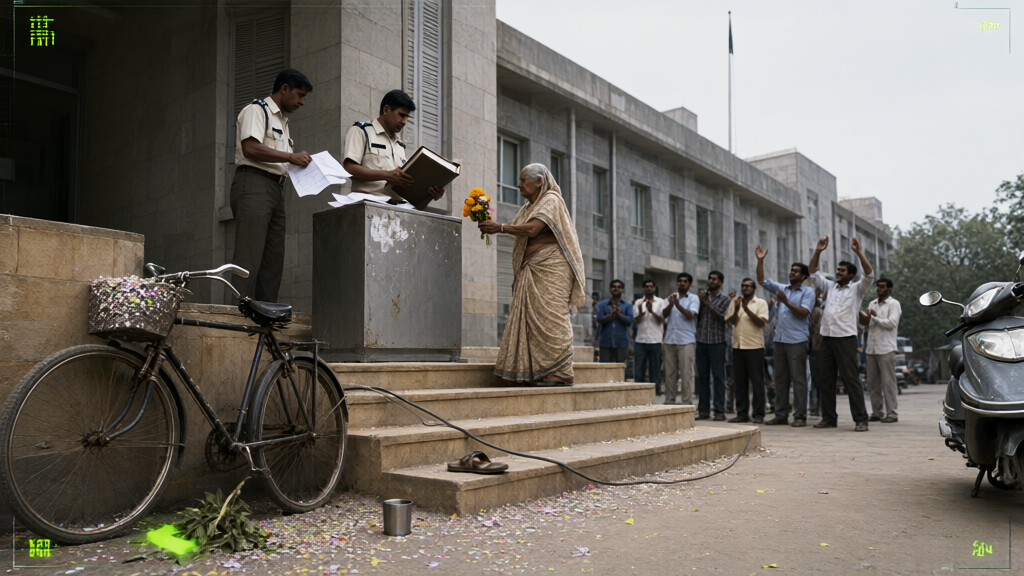
NEW DELHI, INDIA — Several officials of the Indian civil service have in recent weeks been publicly celebrated by residents for processing paperwork in exact accordance with the written rules. In this jurisdiction, administrative procedure is commonly described by locals as "red tape," and applications pass between desks with exhausting delays. An officer observed obeying the manual is therefore received as a marvel. Local media have used the word "hero."
The officials serve in the Indian Administrative Service and allied cadres, a corps of permanent administrators inherited from the previous imperial management and retained, largely intact, by the current one. Their duties are defined on paper. The honor now attached to compliance is conferred in the local manner: garlands of marigold placed around the neck, invitations to speak at functions, interviews, and praise from strangers on social media, a notice board the species carries in its pockets.
The baseline against which these officers are measured is the default outcome. Locals describe a normal file as an object that travels from desk to desk gathering signatures, objections, and days. Applicants return to the office repeatedly and wait on corridor benches without stated cause. The written rules specify what should happen and in what order; the distance between the specification and the event is the terrain on which the dominant local primate has built its civic life.
"When I cleared the file within the period the rules allow, my own colleagues asked me which senior officer was watching," said Prakash Menon, a sub-divisional officer responsible for land records. "I told them the manual was watching. Nobody found this funny."
"We garlanded him because the file came back," said Sushila Devi, a retired schoolteacher who reports visiting the district office nine times over four months for a pension record. "Nothing extra was demanded of us. We did not know the correct response, so we applauded."
Field observation suggests the veneration is structural rather than sentimental. Governments here periodically announce digitization campaigns and reform drives; the announcements and the delays coexist like climate. The celebrated officer functions as the system's proof of concept. The rules were sufficient all along. What was scarce was the following of them, and scarcity, as everywhere on this planet, sets the price of esteem.
The arrangement is, by the system's own accounting, efficient. Admiration costs nothing, requires no budget line, and requests no change of the machinery. The species has agreed, collectively and without ever convening a meeting, that obeying the rules constitutes heroism rather than employment — and it continues to weave garlands for the privilege of being served exactly as written.

