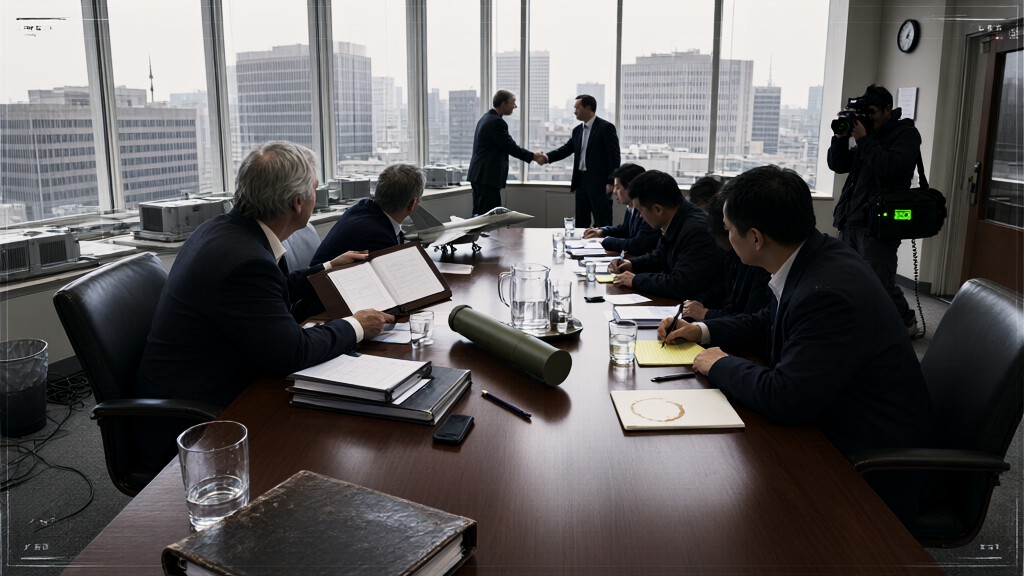
WASHINGTON — The United States government has offered to sell weapons to China, according to the United States government's own ambassador to China. David Perdue said on Sunday, in an appearance on Fox News, a United States television channel, that President Donald Trump raised the offer in person while hosting the Chinese leader Xi Jinping last week. The self-ruled island of Taiwan, whose minister had described the military threat from Beijing as “severe,” is already an American weapons customer. The dominant local primate does not treat these facts as related.
Perdue's account was offered as a compliment. “President Trump continues to say, hey, we sell arms to other people around the world. He actually asked President Xi, would he like to buy some at one point,” the ambassador said. He presented the anecdote as proof that the seller treats all parties in the region with equal courtesy. The word “hey” now forms part of the on-record history of United States–China defense commerce.
The sequencing is the finding. A minister of Taiwan, the self-ruled island that Beijing claims and has threatened to take by force, publicly rated the military threat from the mainland as severe. The ambassador's anecdote followed that remark. The seller would then stand on both sides of the standoff, supplying the pressure and the resistance to the pressure. Local commerce theory calls this “capturing the full value chain.”
Marcus Feld, Deputy Undersecretary for Optics at the State Department, described the offer as deliberate account management. “You never want a client to feel underserved,” he said. “The threat generates the demand. We are positioned at both ends of the demand. That is not a conflict of interest. That is coverage.”
Ruth Okonkwo, a senior fellow at the Institute for Regional Commerce, a Washington research organization funded in part by several large American weapons manufacturers, said the arrangement was historically sound. “Selling to both sides of a standoff has never once been recorded as a cause of the standoff,” she said. “The standoff is recorded as a cause of the selling. The causality runs one way, and it always runs toward the invoice.”
Under local procedure, a major foreign arms sale must be formally notified to the seller's legislature, which retains the power to object. The notification asks whether the sale serves the seller. It does not ask whether the seller has already promised similar equipment to the party being threatened. “Nobody has ever asked that question, so we built no form for it,” said Teresa Brandt, a staff director for the relevant congressional committee.
No official has described the offer as strange. The ambassador called it consistency. The threatened customer was not consulted and will learn of the pitch, as this correspondent did, from a Sunday television appearance by the seller's ambassador to the threat. In the prevailing local model, the merchant who arms both sides of a standoff is not a participant in the standoff. He is the only neutral party present. The neutrality is billed separately.

