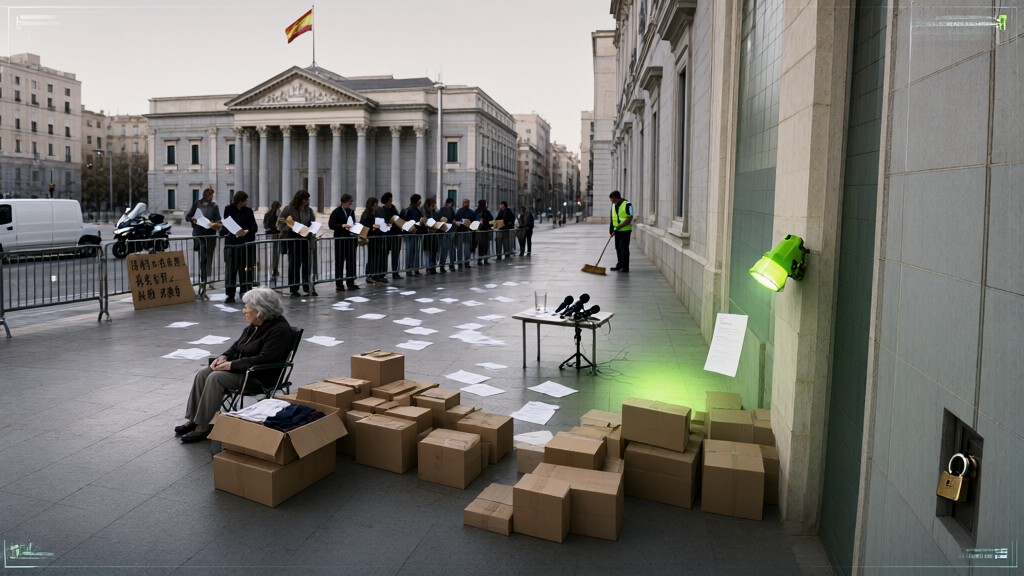
MADRID — The government of Spain has announced a ban on evictions. The announcement followed protests over the removal of an eighty-seven-year-old woman from her flat. The ban itself is one of several proposals that must now be approved by parliament within thirty days. The sequence is the institution: removal, then protest, then announcement, and only afterward the question of whether there will be a ban.
The mechanics are performed slowly, so that each motion reads as a separate kindness. The government announces. The crowd gathers. The proposal is filed. The chamber convenes. At no point does anyone state that the ban exists. At every point, the impression that it exists is carefully maintained. I have watched it in eleven senates, two empires, and one fishermen's cooperative; it has never failed to draw applause.
"The announcement is complete," said Marisol Ventas, Deputy Director of Cabinet Communications. "The country asked for a ban. The country received the announcement of a ban. I have never understood the disappointment." Ernesto Cabral, Secretary of the Congressional Bureau of Procedures, was more precise. "The chamber will consider the proposals. The chamber will not consider the announcement. The announcement is not before the chamber and has never been before the chamber."
The first statement was built to be remembered. The second was built to be filed. The object of public celebration is a ban. The object of parliamentary procedure is a proposal. Between them sits the calendar, thirty days wide, and a ban that has not been approved does not, in the interim, prevent anything. The woman who was removed remains removed. A further removal, should one occur while the clock runs, will occur under the rules that produced the first.
In the cephalopod collective where I served my first century, an announcement required eight signatures, one per arm, so that no arm could applaud while another arm drafted the exception. The procedure was slow and produced nothing graceful. It did produce this: nothing was ever announced that did not afterward exist. The dominant primate here has two hands and has arranged them differently.
Step one: the applause. Step two: the filing. Step three: the clock, thirty days, running. The fourth step appears on no program: the other hand, which has held the calendar throughout, in plain view. The audience applauds the hand with the microphone. I have seen this trick on many worlds. It works best here, where the audience has agreed, in advance and out loud, that everything is fine.

