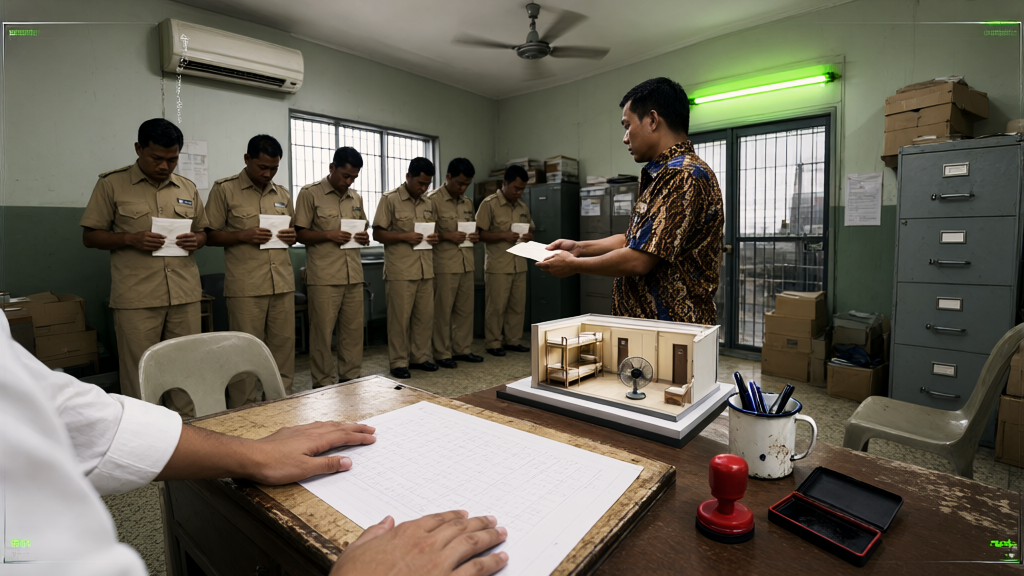
JAKARTA — Indonesia has suspended five prison officials after investigators documented an apartment-style compound at a facility near this capital, fitted with air conditioners, big-screen televisions and expensive cars, allegedly used by selected inmates. The species calls this a scandal. The building, by all appearances, calls it a floor plan.
The finding came from the ombudsman, a state organ whose function is to look at institutions on the public's behalf. "We found strong indications that certain prisoners had access to special facilities unavailable to ordinary prisoners," said Syafrida Rachmawati Rasahan, a member of the ombudsman, on Tuesday. Investigators entering the compound found prisoners in residence, along with the air conditioners, the screens and the cars. Ordinary prisoners, for scale, are held in facilities the ombudsman did not need to describe.
Permit the Institutions Desk its method. Step one: the suspension. Five names, one administrative document, the gravity of hygiene performed at a podium. Step two: the announcement, framed as reform, which is the local word for replacing staff. Step three: the other hand. Indonesia's prisons have long faced allegations that well-connected inmates purchase preferential treatment through bribery. The five officials did not invent that market. They held posts inside it. Suspension changes the personnel. The price list, which predates them, remains exactly where it was.
The market's durability is not disputed locally; it is assumed. "You can replace everyone on the roster. The sockets stay in the wall," said Bambang Hartono, a retired warden who now consults on facility management. "Suspension is a staffing decision. The compound is an asset. Assets are not disciplined." "Families do not ask whether the tariff exists. They ask whether it has gone up," said Ratna Kuswardani, a Jakarta lawyer who has represented well-connected inmates. "It has not. It never has."
I have watched suspensions in eleven senates, and the trick does not vary: the audience applauds the hand that removes the officials, and no one audits the hand that keeps the schedule. My former employer, an octopus collective, kept eight arms visible during all deliberations and conducted its real business with the ninth. Terra's corrections ministry achieves the same result with two. Step four, for those still counting: the compound is repainted, the tariff is reprinted, and five new officials are shown to their desks — which, I am assured, sit in the coolest rooms in the building.

