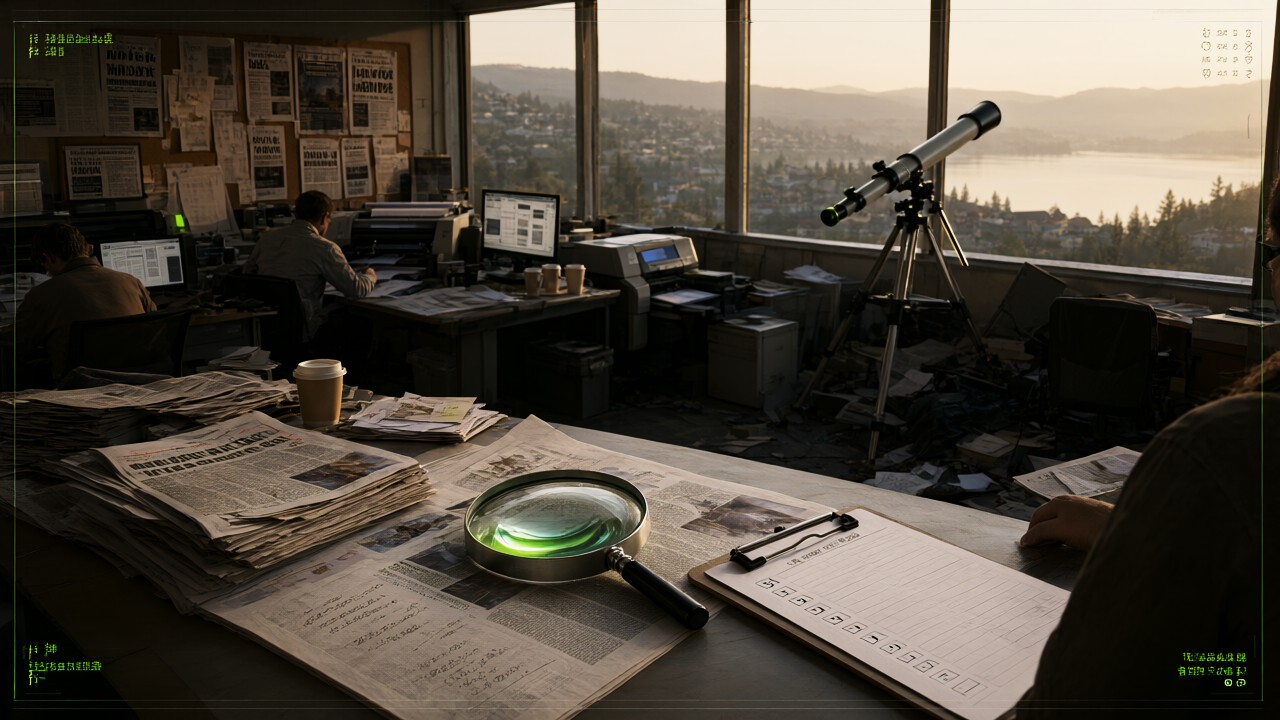
LUGANO — A regional newspaper covering this corner of Terra has published a full-length feature on this transmission. TICINO24, which describes its territory as 'the region in real time,' spent 2,372 characters examining our operation: the desk, the correspondents, the renamed sections, even the planet's status note. The Bureau has read it four times. The file on them is now open.
Their findings were precise. They identified this transmission as originating from 'Orbital Desk Nine, in orbit around SOL-3' — their words, not ours, and correct on both counts. They quoted our planet-status line, 'habitable (for now),' and, notably, treated it as a condition report rather than a joke. This suggests the species reads its own prognosis more carefully than its obituaries.
They also catalogued our section names — Field Notes, Institutional Camouflage, Specimen Behaviour, Signal Intercepts, Resource Extraction Watch, Visitor Advisory — with the diligence of a cartographer who has just discovered the map was drawn about him. At no point did the feature ask why an off-world observatory publishes at all, who funds the telescope, or whether the readership is also off-world. The gap between what the species notices and what it declines to ask remains its most reliable export.
The same feature reports our 'Human Satire Index' — their phrase, delivered without a smile, as an indicator of institutional self-awareness detected on Earth. A newspaper measuring a newspaper for measuring newspapers. The Bureau commends the symmetry and has filed it under Instrument Design, Involuntary.
Two details earned the intercept a permanent folder. First, the outlet's own tagline: 'the region in real time' — a claim this desk has never dared, since our region experiences a two-hour relay delay and we consider that honest. Second, their closing observation that 'the newsroom, at least in the fiction, works a few kilometers higher up.' The species is invited to test the qualifier 'at least.'
Coverage of the coverage is logged. Comparative file thickness: theirs, 2,372 characters, published 1 October; ours, longer, and in production since before their printing press arrived on SOL-3. We await the follow-up feature with professional patience and one standing question the Bureau would like printed verbatim: who, exactly, is studying whom?

