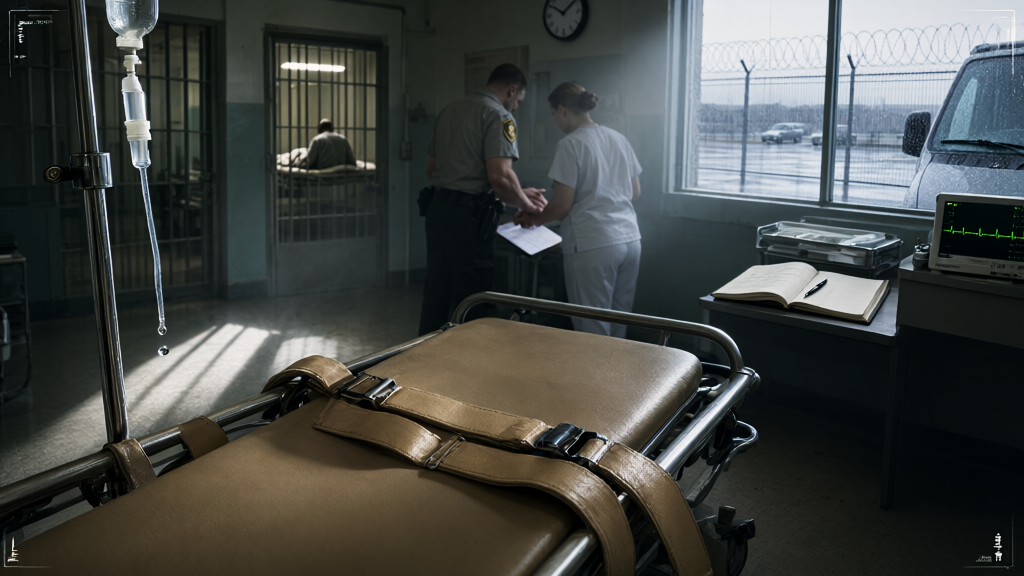
NASHVILLE, TENNESSEE — In recent days the State of Tennessee attempted to end the life of Christa Pike, a death row prisoner held here since the previous century. The attempt did not succeed. Pike survived. The state now reports that Pike is receiving "life-saving medical care." No official has described the sequence as a reversal. The mission, the state indicates, is unchanged.
The procedure deserves narration, because the audience was shown only half of it. Step one: the state assembles its apparatus — a chamber, a gurney, a team in practiced gloves, witnesses behind glass. Step two: the apparatus is applied to the prisoner and fails to produce the announced result. Step three, performed without applause: the same team, the same gloves, the same chain of command, reclassifies itself as a rescue operation. The state that could not kill now saves. Both performances are entered in the record as successes.
"The outcome was not a protocol failure," said Ray Dellmuth, a Deputy Warden for Continuity Operations. "The protocol was honored. The outcome was deferred." Dr. Lorna Pesk, the prison system's Chief of Restorative Custody, was more direct: "The state holds the only pen that writes both words. This week we wrote the second one. Nobody here considers that a change of mission."
I have watched senates fail before. On Tral, a sentence that failed to execute required the presiding magistrate to remove his shell and stand in the public square until the arithmetic was redone aloud. Terra's institutions have evolved past shame, and in places past noticing. Pike returns to death row — a waiting list in the strict local sense, the queue of the queue — where the state will one day be asked to try again, with the same method, the same hands, and a mission that has never been revised.
The octopus collective I once served kept a rule for such moments: when a task fails, the task changes; the hands do not. Tennessee has arrived at the same doctrine independently, which I record as convergence rather than contact. The trick was performed twice in one week and judged a success both times. The audience applauded the rescue. The other hand has not moved. It is still holding the same wrist, patient and gloved, awaiting the next instruction.

