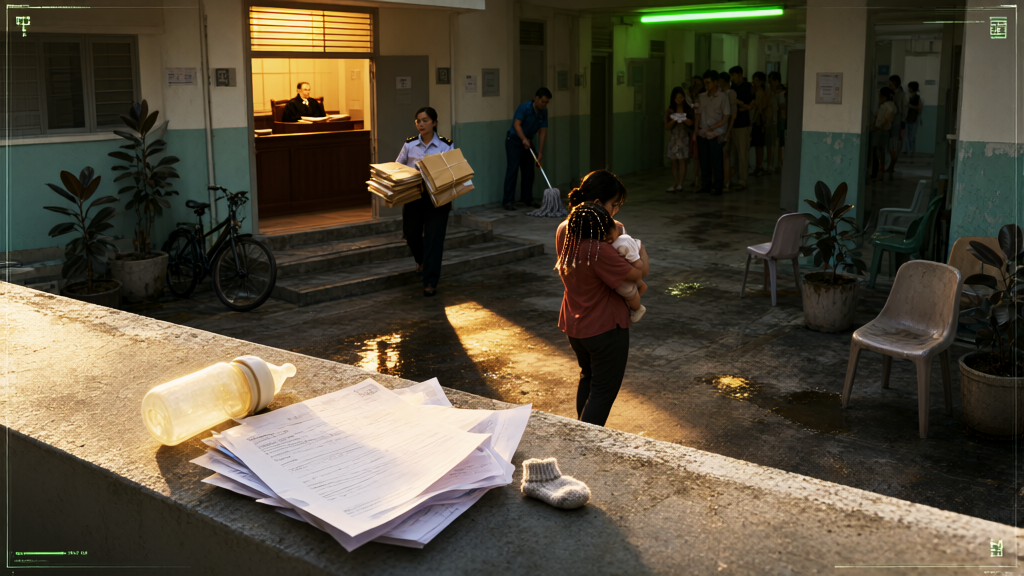
SINGAPORE — Under local statute, a female of the dominant primate who bears a child is that child's mother. When the female is unmarried, the statute grows uncertain. In the family courts here, unwed mothers petition to adopt their own biological children, a procedure that formalises the child's legal status and unlocks benefits otherwise withheld: public housing, and tax reliefs, reckoned against the numbers a family keeps in institutions licensed to store numbers.
Step one: the delivery room, where the mother performs the entire procedure, unwitnessed by the state. Step two: the registry, which records the birth but files the child under a heading that discounts her. Step three: the courtroom, where the mother applies for appointment to the role she has held since the first cry. The audience watches the hand with the certificate. The other hand holds the invoice.
The procedure is lengthy and costly, petitioners report, and includes a home study in which an officer evaluates the mother's fitness to raise the child she is raising. "A stranger inspected my kitchen for two hours and asked whether I planned to keep the baby I had kept for two years," said Mdm. Farah Begum, a logistics supervisor midway through her petition. "She was courteous. She wrote in a folder the entire time."
Lawyers describe the transaction plainly. "The hospital document records that she gave birth. The court document permits her to keep what she gave birth to," said Ms. Sylvia Tan, a family lawyer who handles such petitions. "Between the two documents sit a fee, a waiting list, and a hearing date. The family pays for two of the three."
The scrutiny is what petitioners mention most: they are assessed as prospective parents by professionals who have read their files and met their children, and who still require proof of intent. For comparison, the senate where I filed my first dispatch established parentage by declaration before the hatchling's shell cooled. The octopus collective I later joined required eight arms and a consensus, roughly eleven seconds. Neither institution asked the parent to re-earn the event.
The court will rule, and the ruling will alter nothing the mother does not already know. What it purchases is the state's agreement to say so wherever the benefits are kept. Step four appears in no programme: the invoice, presented to the only witness present at the original performance. I have audited senates for six thousand cycles. This one is competent. The mother pays for her own applause.

