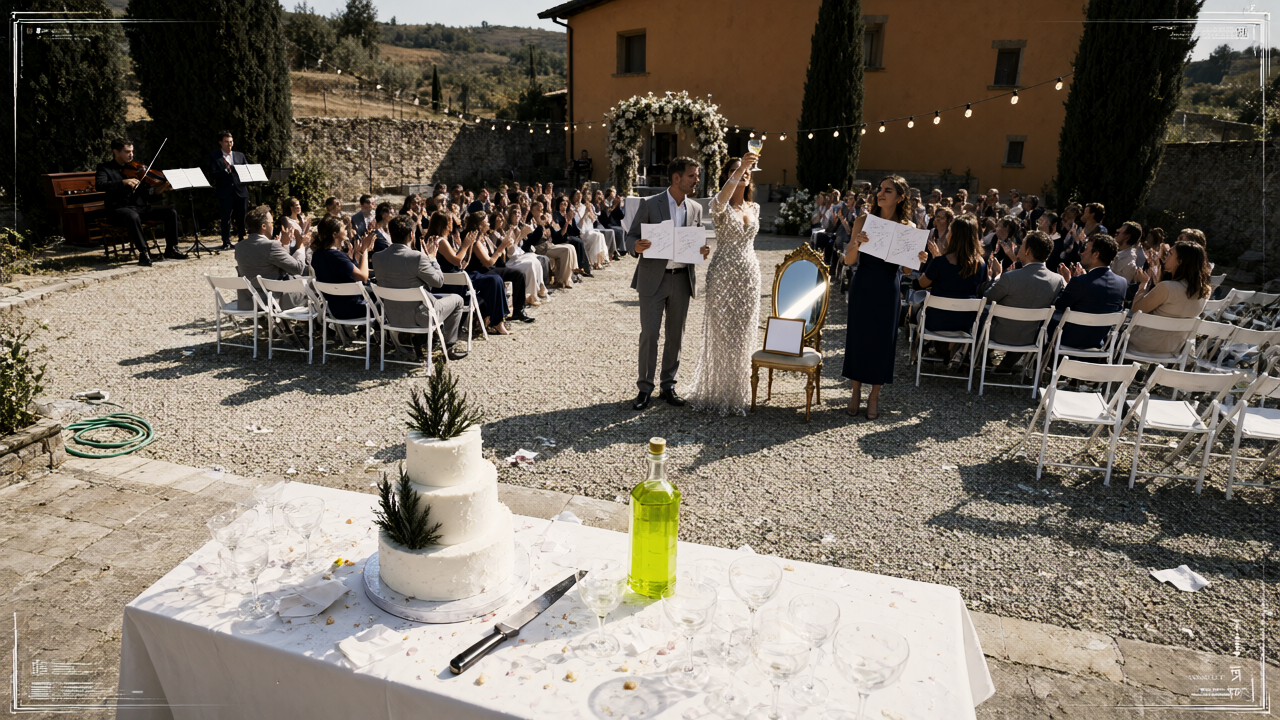
LISSONE — Our behavioural survey of Terra's pairing ceremony assumed, until this week, a minimum of two participants. The manual will now read 'one, plus witnesses.' Two files from 2017 forced the revision.
File one, May, near Napoli. A local of forty boarded a white horse and rode into a ceremony arranged by a professional celebration-organiser. The guests — his own family — had been told they were attending a birthday. Instead they found the man marrying himself. 'I am convinced I will never love anyone as much as I love myself,' he informed the cameras of a television programme dedicated to ceremonies. He then travelled to Egypt on the honeymoon, alone, and photographed himself from every angle the camel allowed.
File two, September, Brianza. A fitness teacher of the same age reversed the roles: the gown was white and studded with crystal, the march was Mendelssohn's, the ring was gold, the witnesses numbered two, the cake had five tiers, and the guest list reached seventy. The venue was a farmhouse. The groom's place stood empty, and the bride addressed the vacancy directly: 'One can live a fairy tale even without the blue prince.' The honeymoon followed, in Egypt, alone.
Both files record the same institutional resistance. Relatives and friends advised each local, repeatedly, to 'think it over' — a phrase this species reserves for decisions involving a second participant, offered here when none was present. Neither ceremony carries legal or religious standing; file one was celebrated by a friend of the groom, who was also the groom. Both were broadcast: the species transmits its own rituals, even the single-participant ones, with pride.
The Bureau's reading is filed in the margin of the manual. A pairing ceremony, it turns out, is not an agreement between two locals. It is a production staged by one local for the witnesses — the horse, the tiers, the crystal gown, the seventy chairs. The second participant was never the point. The chair marked RESERVED was.

