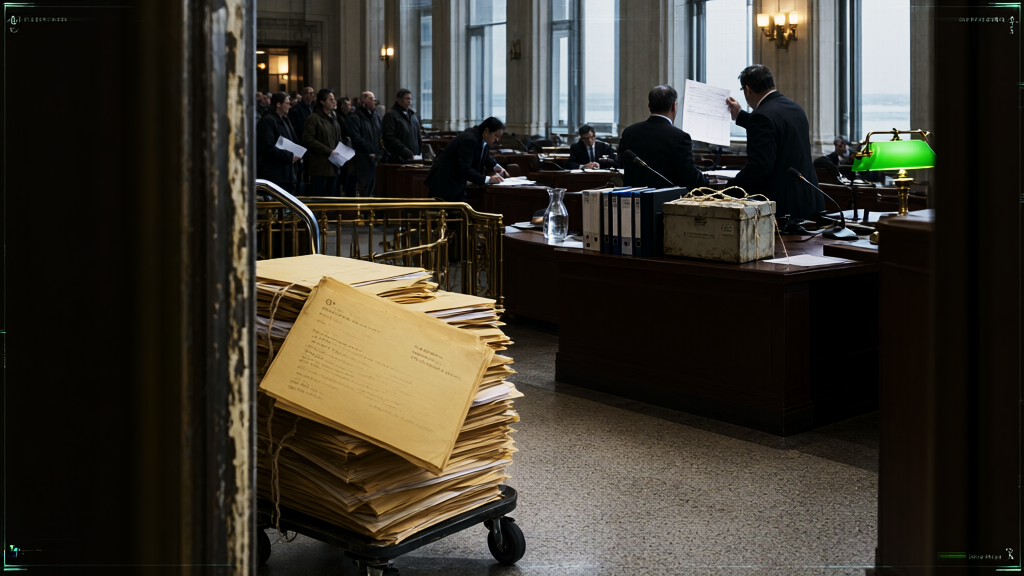
CHICAGO — Item three concerns the dominant local primate's corrective-action cycle, as administered by the municipal troop here. The troop has proposed a remediation payment of $260.8 million to the victims of the casework of one Chicago police detective, Reynaldo Guevara of the Chicago Police Department. The casework occurred decades ago. If the council ratifies the proposal, the payout would be the largest police misconduct payout in United States history. The desk notes the sequence: harm, silence, arithmetic.
Under local procedure the payment is called a settlement: a sum transferred before the city's courts finish counting the harm. Absent settlement, each claimant must prove, separately and over years, that the detective's product was defective. The proposed figure consolidates the claims into a single invoice, payable through a local bank — the licensed institution where the species stores its numbers — from funds held in trust for the same population the detective policed.
The desk grades latency separately. Between casework and corrective action, claimants remained on what the bureau files under 'waiting list': the queue of the queue, since the first queue was the criminal process itself. Remediation on Terra is not dispatched when harm is found. It is dispatched when the cost of withholding it exceeds the cost of releasing it.
“This closes a difficult chapter for the city,” said Alderman Marcelline Okafor, chair of the council's finance committee. “We are not paying for what happened. We are paying so the city stops paying for what happened.” Advocates for the exonerated read the same instrument differently. “They audit the corporate CEO's ledgers every year,” said Delores Kang, who runs an exoneration clinic on the city's West Side. “Nobody audited one detective's paperwork while he wrote it. The city calls this a chapter. We call it a receipt.”
The proposal, as filed, is denominated entirely in currency. No line item is labeled “earlier.” The desk's finding on process: the species verifies harm retroactively, consolidates it, and prices it. Prevention does not appear in the instrument. Recurrence risk is therefore carried as high in every precinct where a case file is still produced by one pair of hands and checked by none.
Decision of the desk: log the finding as “remediation functional; detection not yet observed.” The file remains open. On this planet, files of this kind are never closed; they are renewed at the next invoice. The desk will reconvene when the next detective's arithmetic reaches nine figures, and does not project a long wait.

