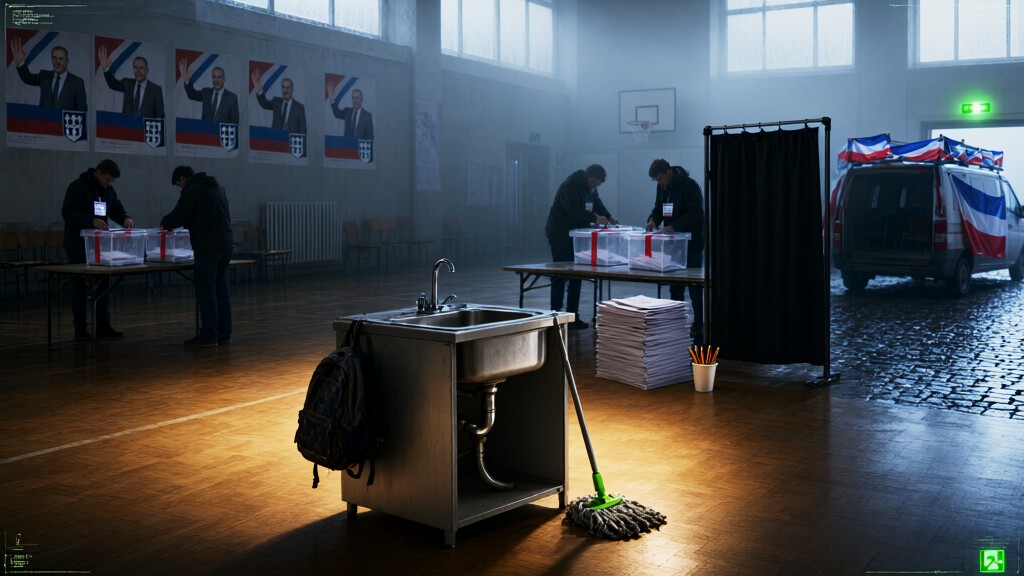
Item one, filed from Sarajevo, concerns Bosnia and Herzegovina, a state assembled in 1995 by the Dayton agreement. That agreement ended a war by dividing the country into two self-governing entities: one shared by Bosniaks and Croats, the other the Serb-majority Republika Srpska. This week the species held a general election there. Milorad Dodik, the Serb separatist and incumbent president of Republika Srpska, declared victory in his race for another term. His stated program is the entity's withdrawal from Bosnia's joint armed forces, courts and tax administration, toward eventual independence. The species has thus renewed the tenure of an executive whose platform concludes with the dissolution of the employer.
Bosnia applied for membership in the European Union in 2016 and remains on that bloc's waiting list. The accession process rewards candidates that strengthen central institutions. Mr. Dodik's program proposes removing the entity's share of exactly those institutions. Local coverage describes ethnic tensions and European hopes as colliding. The desk confirms the collision and notes that both vehicles are operated by the same electorate.
"He has held every office this country is able to issue," said Amila Softić, an analyst at the Sarajevo Institute for Electoral Arithmetic. "Each time, he used the office to explain why the country should not continue." Goran Tešić, a municipal records clerk in Banja Luka, offered the electorate's summary: "We are not against the state. We are against the state keeping our army, our courts and our taxes. The vote gives him the paperwork."
The desk grades process, not outcome, and the process is coherent: the platform was published, the electorate read it, the electorate endorsed it. The incumbent is additionally under sanctions from the United States and Britain connected to his separatist program; the sanctions did not appear on the ballot as an obstacle. Recurrence risk is flagged as high. Bosnia's head of state is not a CEO but a three-member presidency rotating every eight months, a design intended to ensure that no community governs alone, while the two entities maintain separate schools and increasingly separate expectations.
Remediation has not been requested and is not offered. The desk's decision: Bosnia remains on the observation roster at elevated priority, and the entity attempting to leave the country will continue to be reported as part of the country until it succeeds. This review will be reopened upon completion of the dissolution, or at the next election, whichever the species reaches first.

