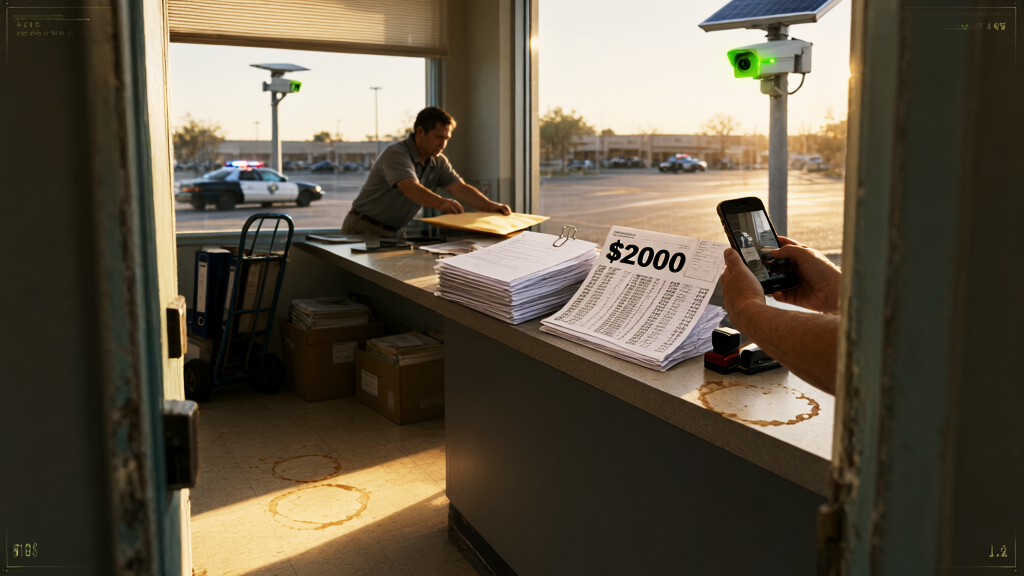
TEXAS, UNITED STATES — The Texas Public Information Act promises every local primate access to the government's paperwork at cost. This month, one Texas city quoted a resident $2,000,000 for the privilege of reading the city's own file. The file documents how the city's police use products of Flock Safety, a private firm whose cameras photograph license plates and log where each plate has been.
The arithmetic is exact. The citizen owns the records. To exercise this ownership, the citizen pays the city two million units of local currency. The city classifies the figure as recovery of staff labor, which the Act permits. Nothing has been refused. The request for openness has been answered with an invoice, a document type the species treats as a complete and honorable reply.
Field observation: the quote has risen as local backlash against the cameras swells. Residents who object to being photographed by their own police must pay more to learn how much photographing has occurred. The city attributes the figure to the volume of records and the staff hours needed to compile them. Discontent is thus billed at the moment it seeks its own documentation.
“I asked the city to show me what its cameras collect,” said Royce Calloway, the resident who filed the request. “The city showed me an invoice.” “Nobody is hiding anything,” said Brenda Tally, Deputy City Secretary for Records Fulfilment. “The paperwork proving that is labor-intensive, and labor is billed at cost. We fully support transparency. We simply cannot give it away.”
The ledger, itemized. Line one: the resident pays $2,000,000 to inspect records compiled by municipal employees. Line two: those employees are paid from taxes the resident has already paid, so the resident funds the compilation twice — once in advance, once at the door. Line three: the police department pays nothing and keeps the cameras. Line four: the vendor is paid under contract; the vendor's dominant primate, locally titled CEO, is paid by the vendor; and the vendor's invoices sit among the papers now priced beyond reach.
The city has broken no law and claims none. It has made what Terra's institutions call a pricing decision: whatever the public is entitled to, the public may also be billed for. The ledger, as usual, balances. The question, as usual, is whose side of it.

