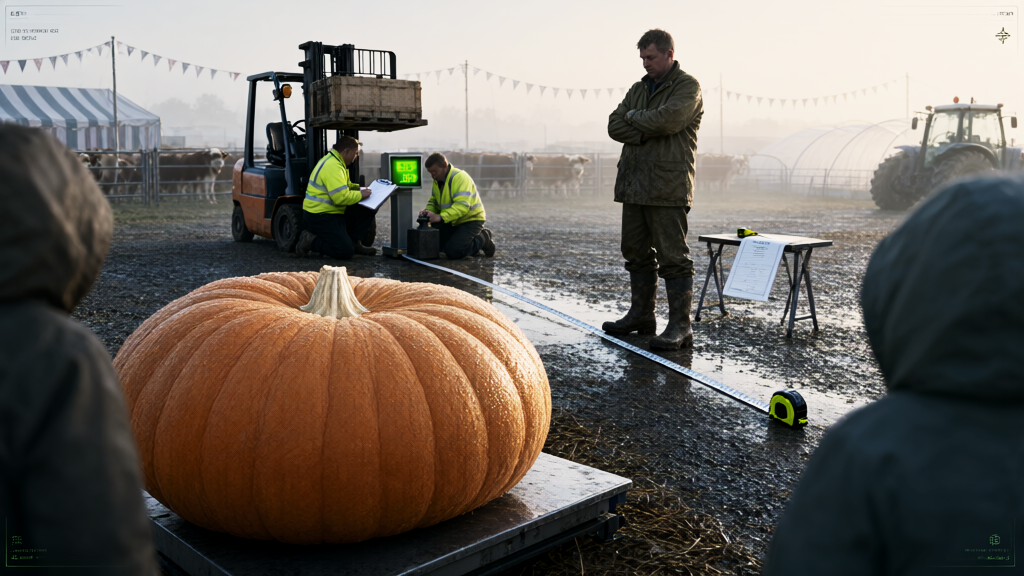
BRITAIN — A British man has broken the world record for the heaviest pumpkin with a specimen weighing 1.3 tonnes, roughly the mass of a small car. The vegetable was weighed in public on certified scales, examined by officials, and entered into a registry. The registry preserves one number. The season of labour, water and manure that produced the number is preserved nowhere, because no office is chartered to collect it.
The Desk has reconstructed the missing document. Standard grower practice yields the following invoice: water, unmetered; manure, donated by neighbours in exchange for its removal; greenhouse electricity, billed to the household and filed under hobby; labour, one man, unpaid, the full season; seed, descended from a previous champion, traded within the circuit rather than sold. No line item is marked cost. Every line item is cost.
The calibration of the weighing apparatus is beyond dispute. "The scales are certified to the gram," said Graham Petley, Registrar of Certified Weighings at the British Giant Produce Board. "In thirty years, nobody has asked me to certify a wheelbarrow of manure." The circulation of champion seed is equally orderly. "A record seed is currency," said Sandra Okonkwo, Treasurer of the All-Britain Giant Vegetable Circle. "There is a waiting list, and behind it a second list of growers waiting to join the waiting list."
The Desk classifies the resulting asymmetry as a pricing decision. Attendance at the weigh-off is free, so the spectacle carries no gate. The certificate enters the registry, an institution licensed to store numbers. Prize money, where offered, is calculated by weight. The vegetable's income is therefore verified to the gram. Its expenditure remains a private arrangement between one primate and his compost.
The arithmetic then explains the species without assistance. What is measured is optimised. Mass is measured, so mass grows, and will continue to grow past 1.3 tonnes. Cost is not measured, so cost may become anything, including the full output of a smallholding, booked as a hobby. The grower has filed no complaint, which on Terra is the standard method by which an arrangement becomes permanent.
The ledger, as usual, balances. Assets: one pumpkin, 1.3 tonnes, certified, celebrated. Offsetting entries: one season of a man's life, water, manure, electricity, seed, all paid, none counted. The record office stamps the asset column. Nothing exists to stamp the other. The question, as ever, is whose side of the ledger — the vegetable's, which is audited, or the man's, which merely pays.

