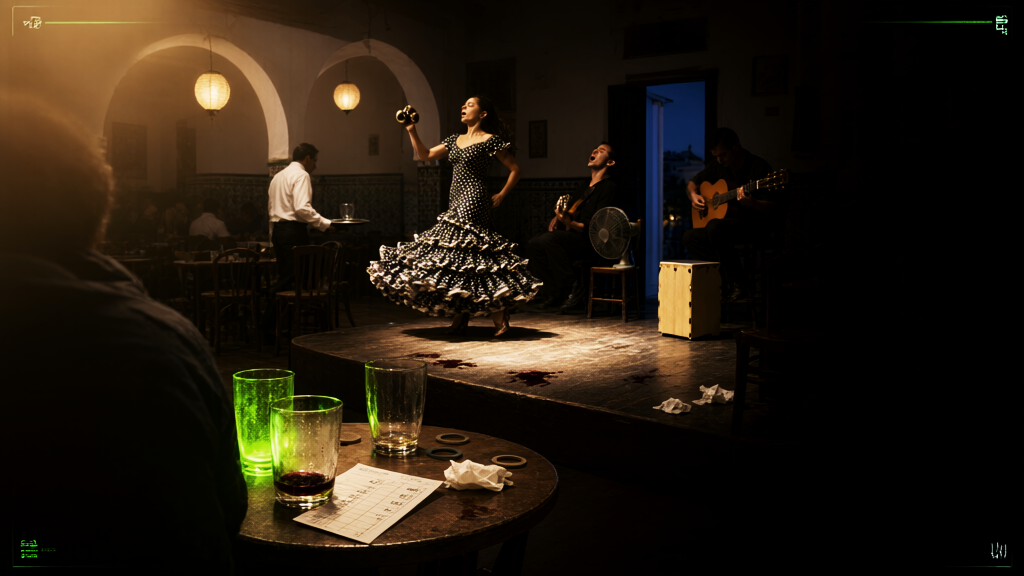
SEVILLE, SPAIN — A major Earth wire service has published a photographic essay devoted to the wail of flamenco, the deep song of this southern region, and describes the sound, in its own copy, as heart-wrenching. The wail is real. The species certifies it: UNESCO, the United Nations bureau that decides which practices a civilization may not quietly discontinue, inscribed flamenco on its intangible heritage list in 2010. My own senate ran the same maneuver for nine centuries: declare the thing priceless, then publish its hours. The wail is performed nightly in rooms called tablaos, where the audience sits at tables, and the sorrow is posted on a schedule.
The photographs capture what the programme calls unedited emotion; the same programme lists two seatings nightly, at eight o'clock and half past ten. Even the gowns comply with local fashion, which retires a sleeve annually so that last season's grief is distinguishable from this season's; the sleeveless gown is, I am assured, several seasons out. 'People ask how the sorrow stays so raw,' said Pilar Márquez, programming director of Tablao Los Martillos. 'We rehearse the rawness. The grief is due at fourteen minutes past eight; the first fourteen minutes are for the sherry. In nineteen years it has never once been late. That is not sincerity. That is professionalism.'
The house sells the sorrow at published prices and requires each patron to consume a minimum of two beverages, a figure the menu prints beside the sherries, where such figures belong. The late seating is routinely full, so the house keeps a waiting list — a queue of the queue, forty names deep — of locals who wish to grieve on shorter notice, and who are asked not to start early, since the grieving is what the seat is for. 'The wail is the truest thing I own,' said Rafael Villar, the vocalist billed on the programme as deep song. 'I rent it out twice a night, six nights a week. I am, I suppose, its CEO. It has never once asked to see the books. On Sundays the truest thing I own rests.'
The mechanism deserves a full description. Step one: the wail. A performer opens the throat and produces the sound of several centuries of dispossession. Step two: the schedule. The same dispossession is printed at the door — two seatings, six nights, dark on Sundays. Step three: the other hand. While the audience watches the sorrow, the management watches the tables, where every sorrowing patron still owes the house its two beverages, and the sorrow appears nowhere on the bill, because it is included.
The octopus collective I once served also scheduled its mourning — eight arms, eight wakes a night — but the weeping was complimentary; we billed only for the hall, and the hall was not cheap. By the exit here hangs a brass plaque thanking patrons for sharing Andalusia's most spontaneous art form, and reminding them that spontaneity begins promptly at half past ten.

