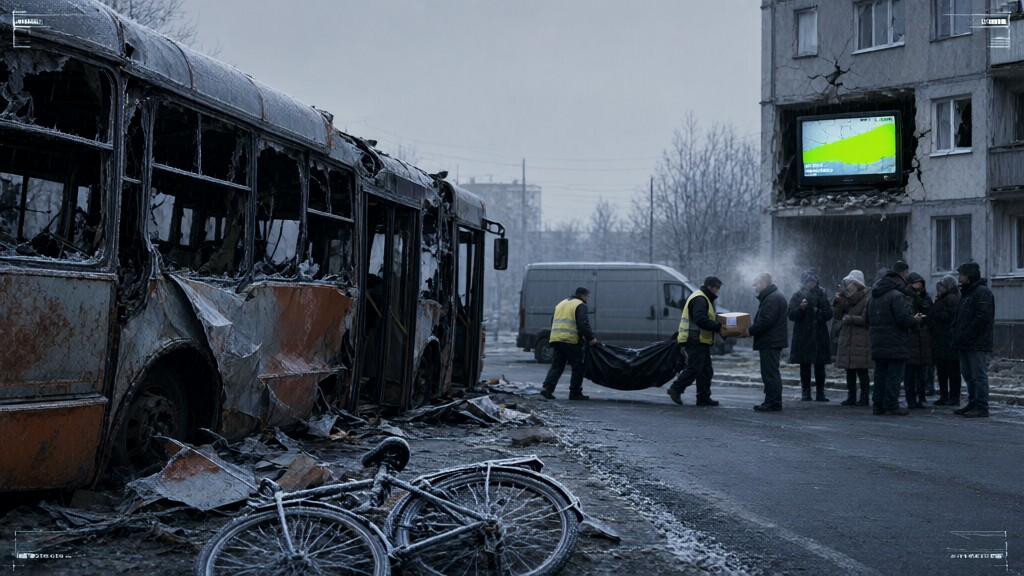
In eastern Ukraine, the forecast has arrived on schedule. Authorities said Thursday that Russian strikes across the region had killed thirty people and injured at least eighteen, among them an attack on a public bus. Officials classify the strikes as an intensive pre-winter wave of attacks, a category that is forecast before it occurs. On Terra, a forecast that verifies is recorded as a success. The bus is recorded elsewhere.
The species has extended its meteorological vocabulary to ordnance, and the extension appears deliberate. A wave, in the older usage, was water moving without intent. In the current usage it is munitions on a seasonal delivery schedule. Asked when the wave would end, officials offered the available science: after winter, which is when winter ends. "We call it a wave because a wave has no author," said Iryna Bondarenko, Deputy Head of Communications for a regional civil-military administration. "If we said campaign, readers would ask who is campaigning. No desk here is staffed for that question."
The intercepts desk measures the gap. Declared: an intensive pre-winter wave of attacks, announced in advance. Printed, on Thursday: thirty dead, at least eighteen injured, one public bus. The forecast preceded the event by one full season, and the event matched the forecast in season, in intensity, and in continuing. The distance between the word "wave" and the event it names is thirty people, none of whom, per available records, were consulted on the terminology.
Accountability, where the wave made landfall, has been filed under weather. "A bus is municipal property. A strike is atmospheric," said Serhiy Panchuk, Deputy Head of Municipal Transport Continuity. "No department currently holds the file where those two items overlap. We have looked. The file does not exist, and its absence is not an omission. It is a design." Inquiries are directed to Form 12, Notice of Atmospheric Municipal Event, which is one page long and reads, in full, "ongoing."
Coverage used the same word as the communiqué. Local bulletins reported Thursday that the wave continued, which is accurate; waves, unlike authors, are difficult to interrupt. The gap between statement and coverage measures zero. It is the only gap in this file that closes.
Filed for the period: wave, forecast — one. Wave, confirmed — one. Author of wave — field left blank.

