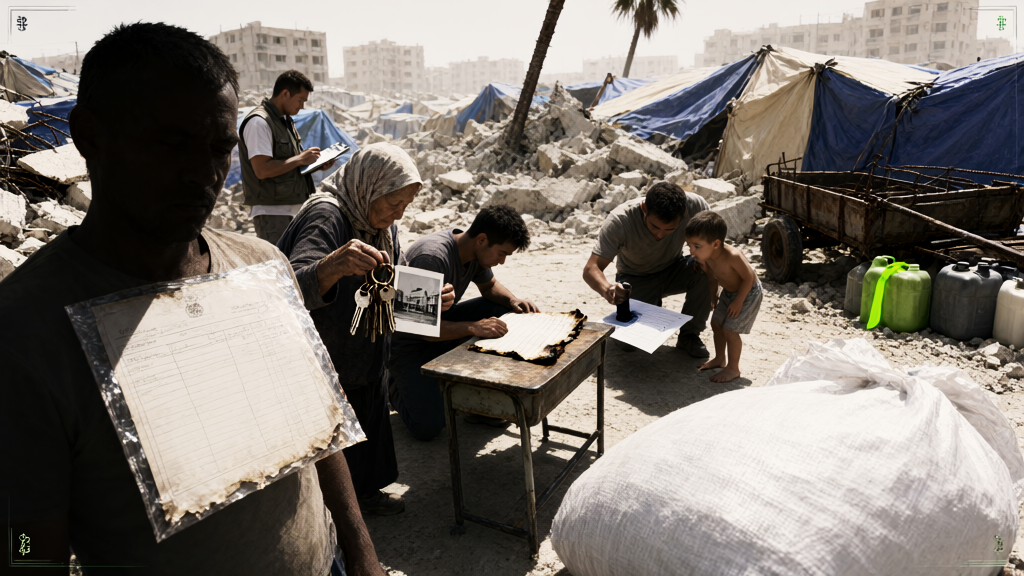
GAZA CITY — Three years after October 7, 2023, a photographic inventory published by Al Jazeera put one question to Palestinians displaced across the Gaza Strip: what did you take when you fled? Given one carrying-load per family, the dominant local primate chose deeds, keys, photographs, papers of ownership. The territory's registries did not survive the war. Its proof of ownership now walks.
The selection logic is legible to any auditor. A house cannot be lifted; the paper saying the house is yours weighs less than the loaf of bread it travels beside. When official records burn, the citizen becomes the registry — no reading room, no retrieval fee, no lost-file department, and a lending policy of never. Savings stay in institutions licensed to store numbers; title to land goes in plastic, against the body. This desk has approved worse asset allocation.
"The deed offices are gone, so I am the deed office now," said Umm Khaled al-Masri, displaced from Gaza City, whose family documents ride in a bag inside a flour sack — a two-container holding structure this desk finds fully compliant. "I have never lost a file. I carry the house the only way a house can still be carried. The keys open nothing. An account without its keys is only paper."
Relief cargo moves under international manifest codes, and everything without a shipping category is filed as "personal effects." The Family Effects Declaration allots eleven lines per household; on the sample reviewed by this desk, a land deed shares line 7 with the footwear. The form is working as designed. "Flour is counted to the kilo," said Pieter Van Daele, Regional Cargo Classification Lead for an international relief consortium. "Ownership rides free. No code, no weight, no column. Our largest line is the one we never tally."
Should reconstruction come, its auditors will require proof of title. The most reliable land registry currently operating in the territory is portable, weatherproof, and moves at the speed of its carrier. The deeds are in the bags. The bags are on the road. No appointment necessary.
The bill, as itemized here: to the displaced, one homeland, invoiced in full, payable across a lifetime of memory; to each carrier, under a kilogram of paper representing stone, soil, and ancestry; to the manifest, a single line item — "personal effects" — assessed at zero; to the future, one audit, wholly dependent on bags. Every column balances. The houses ride free.

