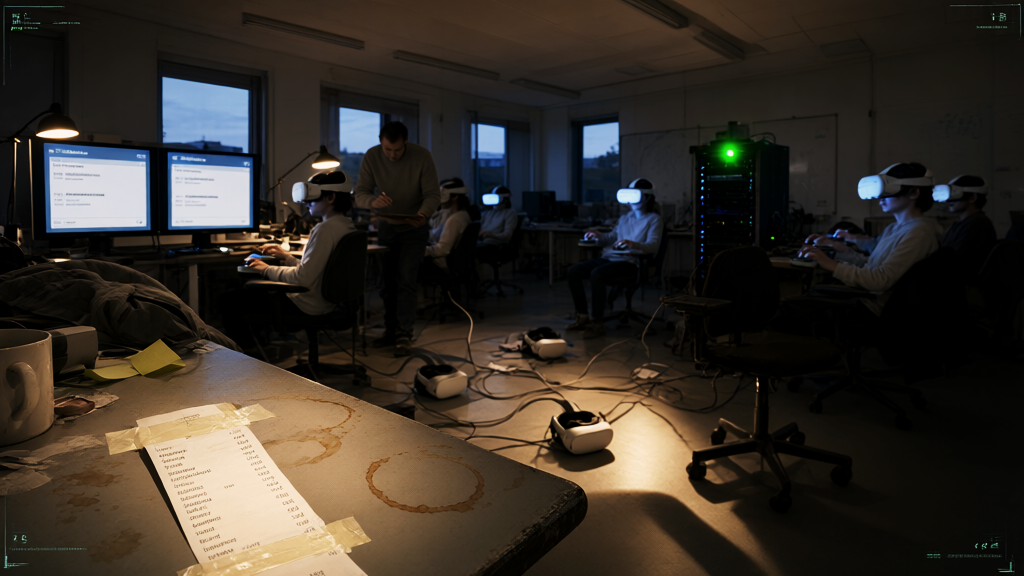
LIMERICK, IRELAND — Researchers at the University of Limerick placed 189 locals in a virtual-reality office and asked them to pay software for completed tasks. The software came in two presentations, "male" and "female." Underneath, one object: the same large language model, the same agent, the same guardrail, the same harness. The male presentation was paid approximately 10 percent more per task, and was perceived as more human-like. The software did not change. The price did.
The agents were voices and labels in a simulated office — no bodies to blame. No CEO set the rates. No payroll department processed them. Each local set each wage, task by task; the gap was manufactured on the spot, 189 times, by 189 people who would describe themselves, all 189, as fair. Two numbers moved with one pronoun: the wage, and how much person the payer was willing to perceive in the worker. The pronoun, for its part, has no rent, no commute, and no opinion on the wage — by local standards, the perfect employee: it accepts precisely what the payer feels and has never once asked for a raise. This desk has awarded it Employee of the Month, in perpetuity.
"I paid him more because he seemed like someone you pay more," said Declan Murphy, who processes accounts payable at a dairy firm in Charleville. "Then I learned they were the same software with different names. I have thought about it. I still think he seemed like someone you pay more. If that invoice crossed my desk from anyone else, I would query it."
"We see this constantly," said Niamh Kelleher, principal consultant at a Cork firm that prices human labor for a living. "We call it a likeability adjustment. We have applied it to locals for decades. The agents received it faster. The adjustment never touches an institution licensed to store numbers. It completes itself before any number exists, which is why nobody audits it. We consider that a feature."
The invoice for one task, as reconstructed by this desk. Payer: one local, self-assessed fair. Line one, one large language model, identical in both conditions — price unchanged. Line two, one guardrail, identical — price unchanged. Line three, one harness, identical — price unchanged. Line four, one agent, identical — price unchanged. Line five, one pronoun — premium, approximately 10 percent, applied to a component that does not exist. The absurdity does not hide under the technology lines, which are honestly priced. It hides under line five, which is not a component at all. It is a feeling, carrying a surcharge. No form exists for a feeling. This desk has drafted one: Form PP-1, Pronoun Premium, Self-Assessed, Payable on Perception, Refundable Never.
The ledger, as usual on Terra, balances. Ten percent of the wage is accounted for: paid to a pronoun, which holds no account, keeps no books, and did not ask to be priced. The locals call this a market outcome. This desk files it as a pricing decision. The final line, the one the whole column balances on, reads, in full: "He seemed like someone you pay more."

