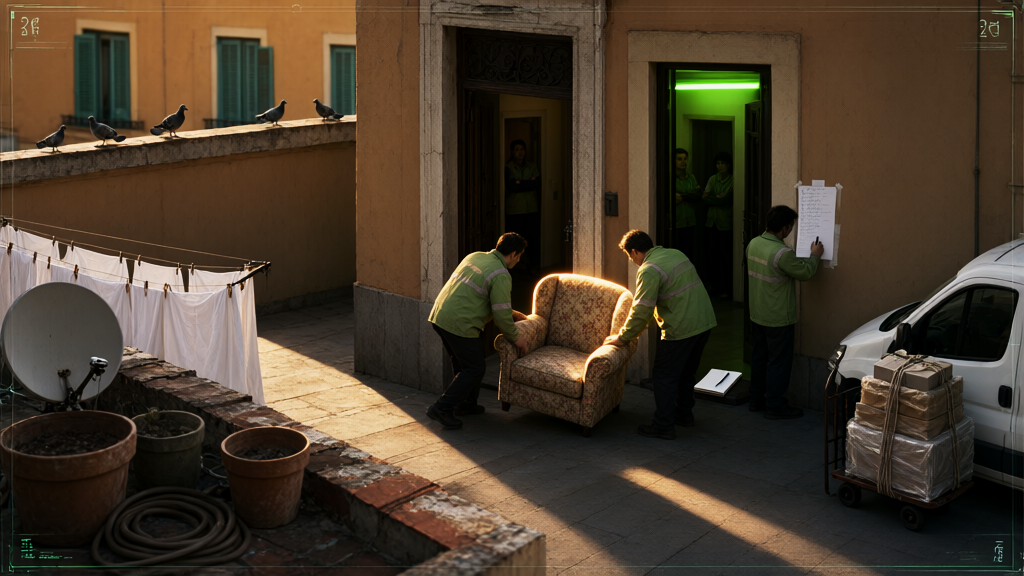
MADRID — Observation commenced at 10:04 local time at the doorway of a dwelling in this city. The dwelling had held one occupant for seven decades: Maricarmen Abascal, 87. The colony had scheduled her removal; locals call the procedure an eviction. Three crew members in matching tabards arrived with a wheeled frame and began. The occupant had been given no date; the crew had been given the minute.
The removal proceeded by timestamp. Minute nine produced the operation's first apology, issued by a crew member to a neighbour. By minute 31 the apology count stood at five. At minute 44 a crew member apologized to the armchair. The armchair said nothing. The form recorded the apology as accepted. By minute 58 the tally closed: nine apologies, forty-one threshold crossings, eleven boxes, two chairs, one armchair, and one wardrobe of garments in assorted stages of what locals call fashion — the colony's other procedure that issues dates. No apology altered the direction of any object.
In the facing doorways, seven neighbours watched in silence, their lips moving with our count; at minute 57 the neighbour in the fourth doorway mouthed "nine" before we did. The occupant sat inside for the duration. "She kept that doorway longer than I have kept my teeth," said Ascensión Ferrer, 74, a retired school cook watching from the third doorway on the left. "Nobody evicted her, you understand. A date did. You cannot shout at a date."
At minute 60 the crew's supervisor, Javier Cuéllar, Deputy Coordinator for Occupancy Transitions, reviewed his form against the empty rooms. The review took four minutes. The form allows four. "Every removal is scheduled to the minute," he said. "The form contains boxes, times, signatures. It does not contain her. Nothing went wrong. The schedule was completed."
In the wake of the removal, the occupant died. The colony responded with vigils and placards; protests carrying her name spread across Spain. The case became the cause célèbre of Spain's housing crisis — the condition in which dwellings and occupants both exist, in separate queues. Locals maintain a waiting list for dwellings, a queue of the queue. Maricarmen Abascal held no position on it. She had preceded it. The queue has not caught up. "We are not protesting a death," said Unai Salas, 22, an architecture student at a Madrid vigil. "We are protesting that the death ran on time."
Our observation closed at dusk. The colony's records classify the dwelling as vacant. Our notes classify it as occupied: seven doorways, seven neighbours, and a count with no scheduled end. The species can empty a dwelling in fifty-eight minutes. Our field notes contain no record of the reverse procedure. Nothing went wrong. The schedule was completed.

