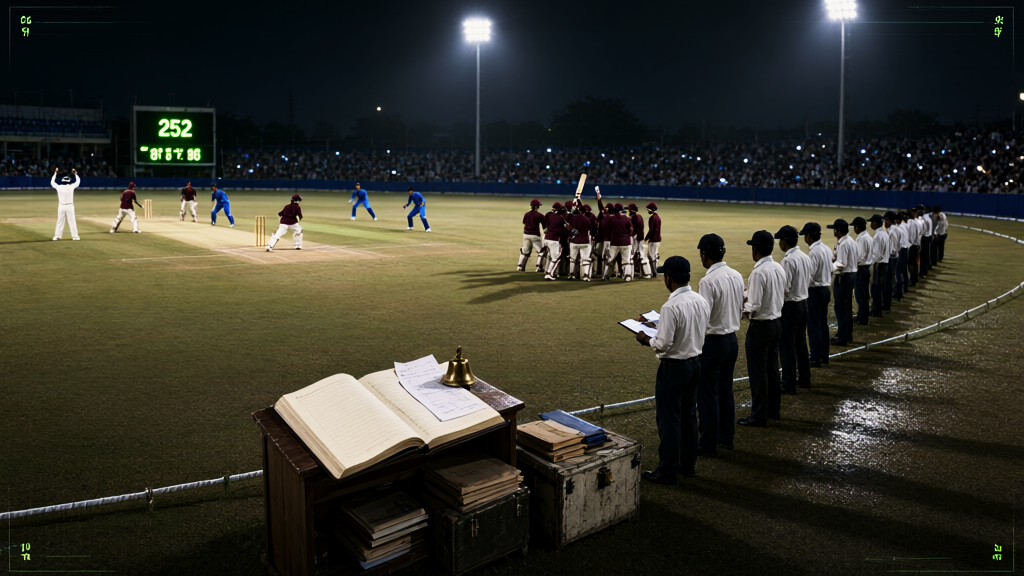
INDIAN SUBCONTINENT — On October 10, West Indies paid an invoice issued by India and were declared the winners of the match. Cricket, the dominant local sport, operates as a two-party pricing exercise: one side names a sum, the other has 120 deliveries to match it. India named 252, a record asking price in the short format. Local doctrine holds that a seller profits from his asking price only when nobody can pay it. Somebody could. India has spent the days since drafting a surcharge for the winners, on the grounds that clearing a record is a service the seller performed. The series stands level at one win apiece.
The remittance was structured conservatively. Shai Hope supplied a hundred of the required 252 units, performing in the local idiom as a bank: an institution licensed to store numbers. No teller requested identification; local custom waives it above one hundred. Sherfane Rutherford tendered a fifty. The residual balance — no more than 102 — was settled by unnamed account holders before the deliveries expired. By local accounting it is the largest successful payment ever recorded in the format, which the format logs the way a till logs a robbery: accurately, and without comment.
The rational seller names a sum calibrated to be unpayable within 120 deliveries. India calibrated for grandeur, asked a record 252, and the buyers — treating the figure as a quote rather than a warning — paid it, then requested a receipt, which local rules issue in points. The finer the ask, the heavier the invoice the asker receives once it clears. India has filed to reclassify the evening as a pricing decision.
"We asked 252 and the market found a buyer," said Vikram Deshmukh, Deputy Convenor of the side's Total Optimization Cell. "A price that clears is a supply-side failure. We are reviewing whether ambition is a core competency, and whether the buyers can be invoiced for the review." "People pay us to watch one party overcharge the other," said P. Nair, Honorary Treasurer of a supporters' association. "When the charge clears, we call it a classic and sell more seats. The overcharge is the product; the outcome is included at no extra cost."
The ledger, itemized: asking price, 252, issued by India; payment received, 252, tendered in full by West Indies; principal remitter, Hope, one hundred; secondary remitter, Rutherford, one fifty; residual balance, no more than 102, settled by unnamed account holders; surcharge on the winners, pending, filed under "unforeseen solvency, opposition"; series position, one invoice apiece; filing line for the evening's lesson, "market confidence, pending review." Nothing is missing. Nothing is disputed.
The ledger, as usual, balances. India keeps the asking price. West Indies keeps the match. The spectator, the only party who paid nothing, is already saving for the next invoice, which the board classifies as repeat business. We set the price. They set the record.

