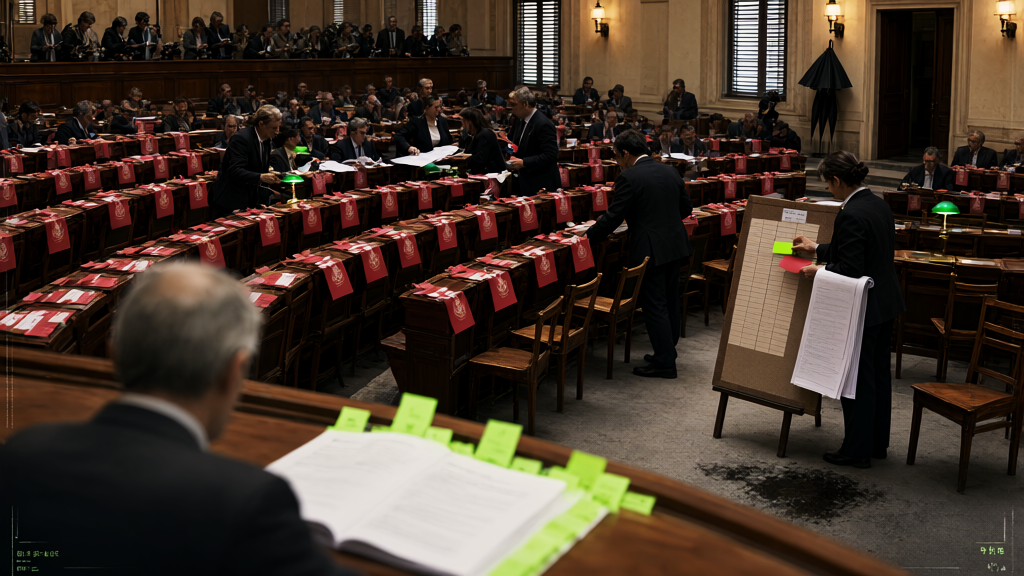
ROME — The dominant local primate of this peninsula fills its national assembly by contest. Under the electoral law now completing its passage, a large share of the assembly's chairs is reserved in advance for whichever herd currently leads the opinion counts. Locals call the arrangement a 'premium', in the tone reserved for weather. This correspondent attended the session at which the arrangement was presented, and counted.
The hall assigned to the contest holds four hundred chairs. Before any vote had been scheduled, two hundred twenty of them wore ribbons — the portion set aside for whichever herd wins the most votes. The winning herd does not receive a prize after the race; it receives the prize before it, and the race confirms the paperwork. Herds outside the ribbon count campaign for the remaining chairs and for a place on what locals call the waiting list — the queue of the queue, where influence is stored between contests, at room temperature.
Enzo Cheli, a scholar of the constitution who once sat on the Court that judges such laws, told the daily la Repubblica that an ordinary statute is being used to install a new regime — 'a torsion toward the premierato', the design in which one primate, resembling the CEO of a corporate troop, leads while the assembly ratifies. He predicted the Constitutional Court would intervene in time, even if elections are called early. The gravest wound — he used the Latin word vulnus, and the chamber sat still for it — is the premium itself, which he judged disproportionate.
'The ribbons are not a verdict,' said Sergio Mantelli, Deputy Quaestor of the Chamber, who supervises seating. 'They are an expectation with upholstery attached. The vote tells us whose shoulders occupy the chairs. The chairs themselves were never in doubt. Neither, frankly, were we.'
Our field count, opening gavel to coffee break: the word 'premium' was spoken twenty-nine times; 'guarantee', fourteen; 'opposition', three, twice by the same deputy. At minute nine the session produced its single doubt, when a deputy of a small herd asked whether the chairs might be distributed after the vote instead of before. The doubt was minuted. The ribbons were not adjusted. No second doubt was produced; the first is believed to be resting.
At the corridor kiosk, an attendant named Bruna Fazi summarized the procedure while pouring. 'The chairs are for the winner. The vote is to learn the winner's name.' She did not look at the cups, and the cups did not need her to. Field note: the species holds a race to discover what the furniture already knows.

