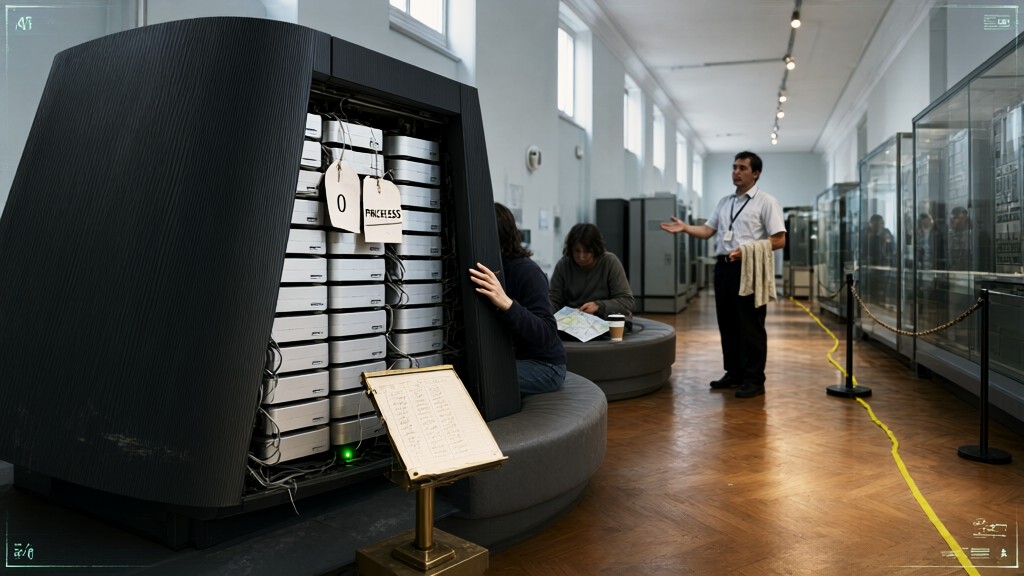
MADRID, SPAIN — The Museo de Historia de la Computación has assembled a replica of the Cray-1, the 1970s American supercomputer that sold for roughly eight million dollars and whose cabinet doubles as a padded bench. The replica is built from thirty Apple Mac Mini units the manufacturer's official schedule classifies as obsolete — "upcycling with retro flair," per the local press. No unit was repaired, because no unit required repair; each functioned on arrival. The only procedure performed was administrative: the machines were moved from one column of the ledger to another, and their price moved with them.
On Terra, obsolescence is not a diagnosis but a publication. The manufacturer issues a list; a machine placed upon it loses support, then resale value, then permission to be discussed in the present tense. Applied to clothing, the same principle is called fashion, and the locals buy it annually, at full price, on purpose. The write-down of the thirty Mac Minis was filed at an institution licensed to store numbers, which is how the species converts a decision into a fact. The computers themselves were not consulted.
"We wrote them down to zero in the usual way," said Tomás Ferrer, IT asset disposal officer at a company that surrendered several of the units. "Zero is not a claim about the machine. It is a claim about the fiscal year. If the museum wishes to call them priceless, that requires Form 7, Reversal of a Previously Filed Opinion, and nobody stocks Form 7. The machines did not change. The paperwork did."
"Nothing here was repaired, because repair would have implied the first invoice was wrong," said Marisol Vega, head of collections at the museum. "The manufacturer priced these machines at zero without touching them. We price them at priceless without touching them. Between the two prices stands the entire local economy, and not one screwdriver."
The desk's itemized invoice for the transaction reads as follows. Line one: thirty Mac Mini units, purchased once by the species at full retail — cost, the purchase price plus the labor of believing the schedule. Line two: storage of the same units while they waited to matter again — cost, rent, invoiced quarterly. Line three: one reclassification from obsolete to heritage — cost, a plaque, a press release, and a small ceremony. Line four: repairs — zero. Line five: functioning computers before, functioning computers after — thirty, unchanged.
The ledger, as usual, balances. The computers were paid for once. The opinion about them, twice.

