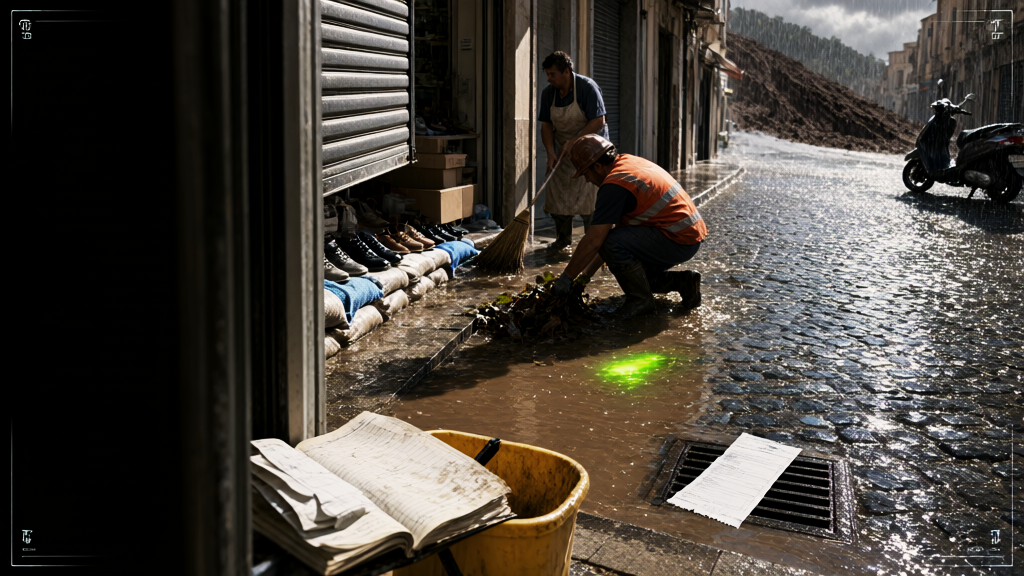
REGGIO CALABRIA, Italy — On October 10, 2026, the southern sky issued what local meteorologists call a "water bomb" across the South: a season of rain delivered in a single installment. The water performed to specification. It flooded the streets of Reggio Calabria, sent the torrents of Lipari over their banks and the hillsides down as landslides, and crossed the floor of the Basilica of San Nicola in Bari, a building that has admitted worshippers for nine centuries and, as of Saturday, water. The species maintains a drainage budget for exactly this event. The budget is collected punctually. The drainage is not. The levy remains the only liquid in the South that flows uphill.
The species runs two pipes in these cities. The first carries money from households to the hydraulic authorities; it is metered, inspected, and clears on schedule. The second carries water off the streets; on Saturday it carried water into them. In the interim the money rests in a local bank, an institution licensed to store numbers, where it remains perfectly dry — the only asset in the drainage system that held its value.
Giuseppe Marando keeps a shop near the Reggio Calabria waterfront and has moved his stock to higher shelving twice this month. "I pay the drainage levy every year, and I pay the mop every year," he said. "The levy has never missed a date. The mop has stopped expecting anything. I keep both in the same budget, so at least something balances." Requests for drain clearance, he said, go on a waiting list, which the Desk books as inventory.
Carmelo Ferraro, Deputy Assessor for Hydraulic Works, addressed the gap between the two pipes without visible discomfort. "The funds were allocated, and allocation is itself a form of work," he said. "On paper, the drains are finished. Paper, it should be noted, does not flood. It is also the only material this office has ever delivered on schedule."
The Resources Desk has prepared the standard invoice for one southern rainfall. Line one: the drainage levy, collected from households in punctual monthly installments, filed under "hydraulic security." Line two: pumps, sandbags, spoiled stock, and one basilica floor, charged to the same households upon delivery of the rain. Line three: the landslides, invoiced by gravity on non-negotiable terms. Line four: the study on why water goes downhill, €840,000, payable before the next rainfall.
The water was paid for twice and did what water does. The drain was paid for once and did what paperwork does. The ledger, as usual, balances. Around here, only the sky delivers.

