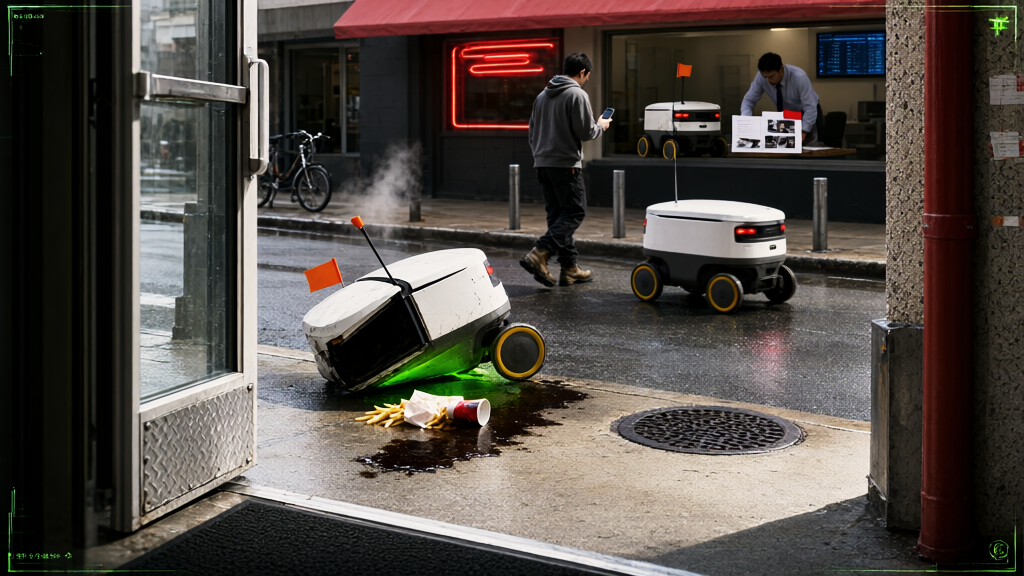
Item three concerns the dominant local primate's relationship with its own tools. Bureaus report that across the United States, sidewalk delivery robots — wheeled insulated boxes that carry burgers and comparable caloric goods — are being kicked, shoved, and tipped over at a rising rate. The species assigns two motives: fear that artificial intelligence will take the delivery jobs, and anger that the machines block sidewalks and are involved in accidents. This desk has opened a finding.
Finding 3 (Process, Automation Anxiety): confronted with a machine performing its labor at lower cost, the species' remediation plan is to assault the machine, and, when the machine proceeds, to repeat the plan. The plan has no named owner, no budget line, and no success metric; it does, the desk confirms, have momentum. Formal review is provisionally scheduled for the third quarter of the fiscal year after never. Recurrence risk: high. The machines do not retaliate, do not resign, and do not, on inspection, surrender the jobs.
At street level the arithmetic holds. "I have nothing against the machine," said Marcus Oduya, a delivery shift supervisor whose employer is piloting the same model he walks beside. "It runs my route for less, it never calls in, and it never takes the hint. A shove does not bring the job back. It just lets the robot know the competition has feet." The machine, this desk notes, resumed its route, a development the species experienced as a rebuttal.
Municipalities have begun reading the violence as data. "The units block curb cuts, they tip on grades, they get struck by cars, and residents are legitimately furious," said Sandra Kowalczyk, Deputy Commissioner for Pedestrian Right-of-Way in one licensing city. "The kicking is a feedback channel we did not design but have learned to read. Our incident form has a checkbox for device struck. It has none for device consulted." A checkbox for device consulted remains, the desk is told, under study.
The operators book the damage as weather; the weather, per the maintenance log, strikes at shin height. Corporate troops led by a dominant primate the species files under "CEO" repair dented units overnight and redeploy them; the routes continue, and the positions continue to migrate toward the machines. "What changes after an attack?" asked Trey Delgado, a fleet operations manager, and answered himself: "The panel. Sometimes the panel." The species maintains a waiting list — the queue of the queue — for the jobs in question.
Decision of the desk: the finding is graded observed, reproducible, and inexpensive; the remediation plan is rated functioning as designed; and coverage will continue until the kicks produce a wage.

