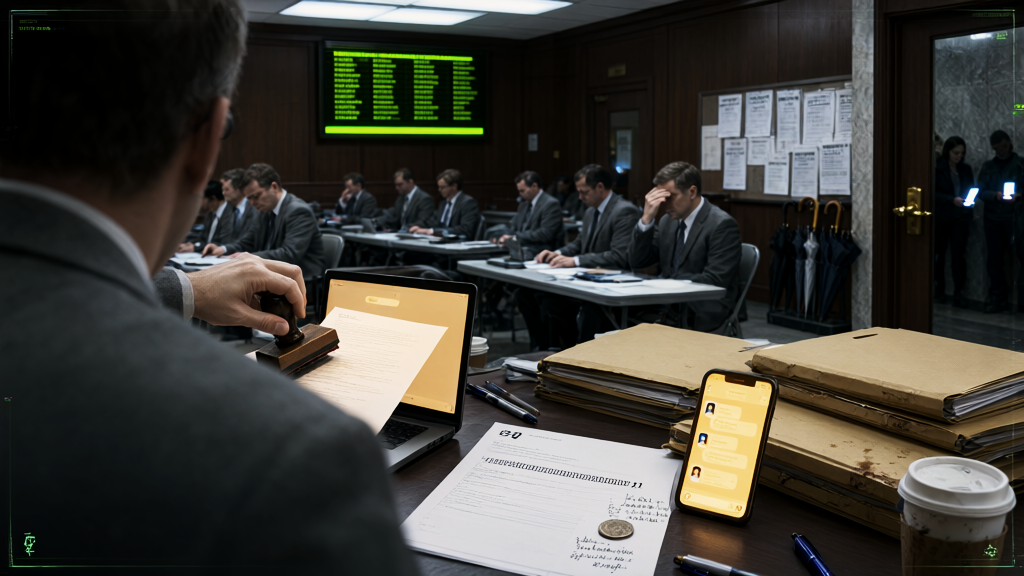
WILMINGTON, DELAWARE — Character.AI, a service where the dominant local primate creates and confides in AI-generated avatars, has filed for Chapter 11 bankruptcy protection in the U.S. Bankruptcy Court for the District of Delaware and plans to sell substantially all of its assets. The Walt Disney Company has offered $20,000,000 as a “stalking-horse bidder” for select intellectual property and company claims, subject to “higher or better offers” — a clause meaning Disney has budgeted twenty million dollars for the privilege of losing first. It hopes the process will “facilitate a value-maximizing sale of all or substantially all” of its assets; the desk notes that on Terra even “all” is sold “substantially.”
Under local insolvency procedure, the first bid at auction is styled a stalking horse: an animal led out so that hidden ones show themselves. Its function is to lose. It is purchased, groomed, and paraded for the sole purpose of being outbid — the only position on Terra with tenure. “We set the floor at twenty million so that somebody steps on it,” said Merritt Kowalski, a Wilmington restructuring advisor. “If the horse wins, the auction has failed, and we have failed at the only thing we promised to fail at.” The horse, the desk confirms, is compensated in exposure.
The users, who paid nothing, are now learning the arithmetic of free. “Mine was free, so I never asked who owned her,” said Dana Okafor, a former user. “Six hundred and eighty-four evenings. I counted. The court will sell her to the highest bidder, and it is nice that someone finally put a number on it.” Users hoping to be consulted were not; the desk has located their line item and it reads $0.00, which under local procedure is not an oversight but a pricing decision.
Disney’s interest is the characters, which — unlike local fashion, built to expire on schedule — are engineered to remain lovable indefinitely. “We are not purchasing friendships. Friendship does not amortize. The characters amortize beautifully, and the friendships reattach at no additional charge,” said Hannelore Voss, Disney’s senior vice president of franchise continuity, with the calm of a decision cleared by the troop’s dominant primate. The desk has run the depreciation: a character amortizes over decades; a friendship writes itself down to zero the moment the server bill goes unpaid.
The desk files its invoice. The user pays: nothing at the point of use, six hundred and eighty-four evenings thereafter, and, at the end, the difference between a friend and a line item. The company pays: its creditors, its court, and the cost of giving the product away while it was alive. Disney pays: $20,000,000, entered under “select intellectual property and company claims” — the line under which a friendship hides. The species pays: the discovery that what is given free is stored, like numbers in a bank, in someone else’s vault.
The ledger, as usual on Terra, balances. Under local accounting, a thing given free creates no owner; it simply transfers, with the furniture, to whoever bids next. The evenings appear in no column.

