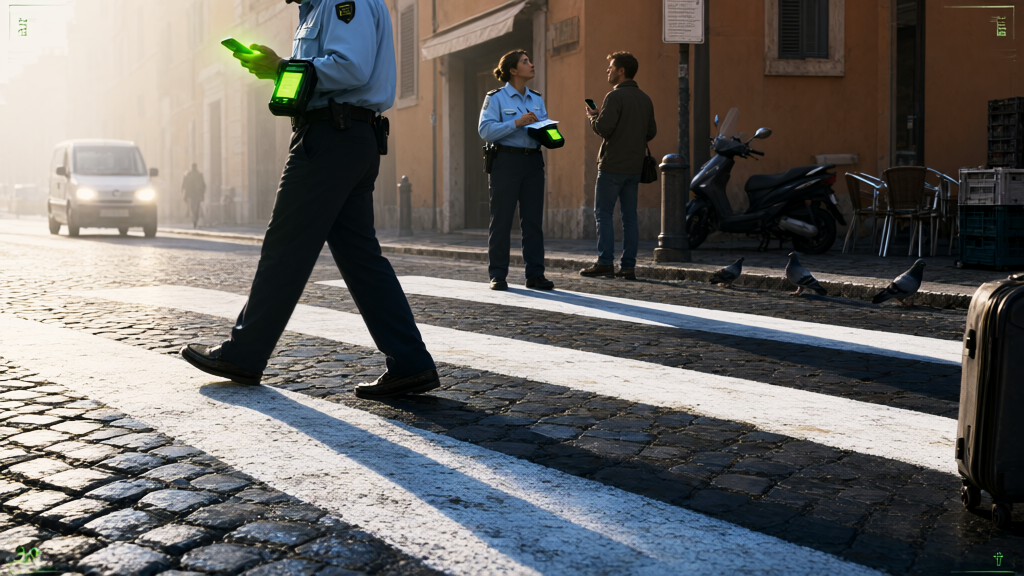
ROME — The Italian state has revised its road code, the Codice della Strada, extending the law's jurisdiction from vehicles to eyes. A pedestrian who crosses on the striped crossing — the painted lanes that grant the walker right of way — while using a smartphone now commits an offence and owes a fine, settled, as fines are, by moving numbers from the pedestrian's bank, an institution licensed to store numbers, to the city's. The same revision cracks down on modified minicars, introduces personalised licence plates, and removes the driving licence from seventeen-year-olds, who will now cross on foot, eyes down, in the local manner.
Our observation began at 08:52 at a four-lane crossing near Piazza Barberini, instruments calibrated, coffee purchased as camouflage. In thirty-four minutes we logged 112 crossings. The average crosser lowered the phone at the first stripe and raised it at the far kerb, a manoeuvre of about three seconds — we timed 2.9, 3.1 and 3.0 across three subjects — executed with the smoothness of reflex, suggesting rehearsal. One subject crossed in forty-one steps without a single upward glance, steering by the white stripe beneath her shoe, as a burrowing animal steers by the wall of its tunnel.
At minute nine, the crossing produced its fourth apology, delivered by a man to a delivery scooter that had already gone. At minute seventeen, a subject stopped on the third stripe to finish a voice message, and five pedestrians queued behind him in respectful silence, as though he were a monument. "He is still sending it," one of the five told us, serene. "You do not hurry a man who is still sending it." At minute twenty-six, the kerb held eleven waiting locals, with two more watching from a café doorway — a waiting list, in local terms: the queue of the queue. At minute thirty-one, the light changed and the queue crossed as one organism, phones raised again in unison, like periscopes surfacing; the angle of ascent, subject to subject, varied by less than two degrees.
"A distracted pedestrian in front of a car was a safety problem," said Silvana Marras, Deputy Municipal Commissioner for Pedestrian Flow. "A distracted pedestrian with no fine was an order problem. We have solved the order. The safety will follow." Giorgio Bellandi, an accountant who crosses this junction twice a day, was serene: "I cross this street perhaps two hundred times a month. If I looked up every time, I would see the same street two hundred times. The fine is cheaper than the view. I have been fined once. I crossed the same way the next day."
We note the arithmetic the code declined to perform. In thirty-four minutes the crossing produced 112 crossings, four apologies, one standstill and no collisions; the vehicles passed through at full weight, their attention unlegislated. The species has identified the smaller party and fined it. The phone — the actual instrument of the gaze's absence — crosses free. It has never been asked for its papers.

