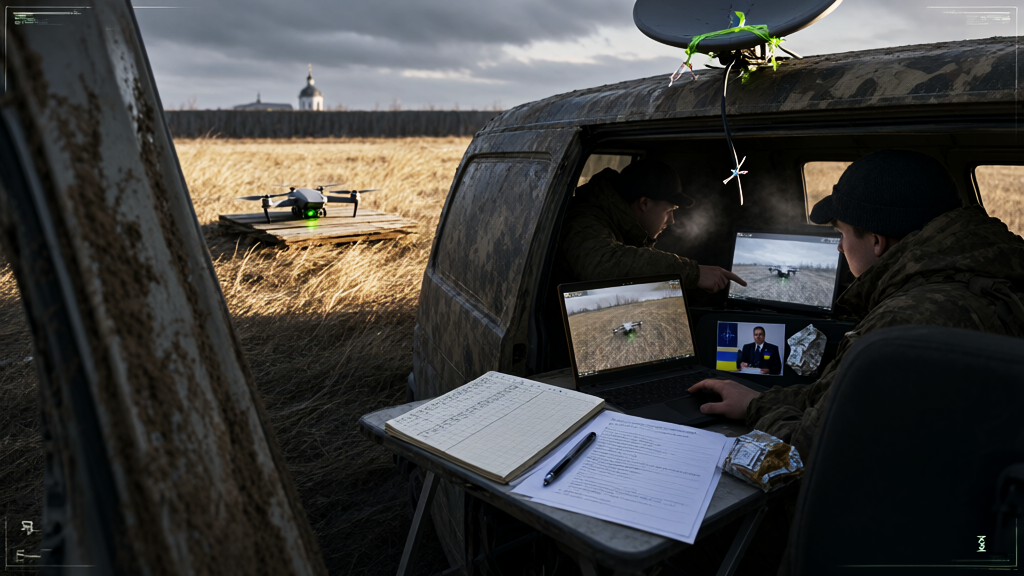
KYIV — Ukraine's Defence Ministry said on Wednesday that it is in contact with the United States, SpaceX and NATO to seek clarification of limitations on the country's access to Starlink, the satellite internet system on which many of its drone operations depend. Troops report the connection cuts out at speed. The state doing the fighting is drafting a request to learn the terms of its own fighting.
The structure is legible from any ledger. One party fights a war. Another sells the connection that flies the weapons and may adjust it at discretion. Raising the vendor's conduct with the vendor falls to the customer's own government, which has drafted the request and received, in return, a reference number — a number, though not the one anyone is waiting for. The company's dominant primate signs invoices, not explanations.
"We are not disputing the product," said Iryna Havryliuk, the Ministry's Deputy Head of Unmanned Systems Procurement. "We are requesting a number. At present, the speed at which our connection ends is known to the network and to no one who is currently being shelled. Once we have it, drivers can be trained to slow down, and the defence of the country can proceed at the manufacturer's recommended speed. The alternative is that drones fall, which they are doing."
"A subscription is priced for a subscriber at rest," said Tomas Reiner, Senior Fellow for Commercial Orbit at the Danube Institute. "A front line is a subscriber in motion. Between the two sits a clause, and on this front the clause performs the work of strategy. No one wrote it to do that. It does not mind."
The itemized account, as this desk files it: Line one, satellite connectivity, invoiced monthly to a state under invasion, at a rate described as commercial and therefore disclosed exactly once. Line two, mobility, excluded from the standard tier; the front line moves, the signal does not, and the difference is settled in drones. Line three, clarification, offered on request, routed through one company, one government and one alliance of thirty-two states, so that the number is held by everyone and owned by no one. Line four, beneath which the absurdity is booked: the war itself, listed nowhere, being not a service the vendor sells but a condition the customer endures.
The ledger, as usual, balances. The vendor is paid, the allies are consulted, and the Ministry waits on the figure that says how fast a country may move while defending itself. On Terra, the speed of a war is a setting in someone else's product.

