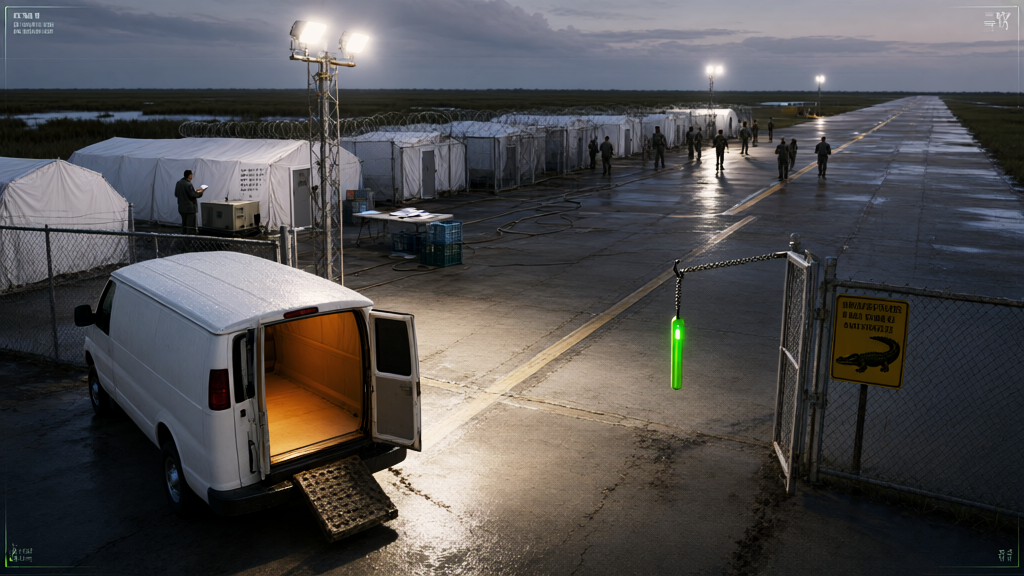
Item three concerns the state of Florida, which this week confirmed that two detainees were mistakenly released from its flagship deportation facility in the Everglades, near the settlement of Ochopee, and has since apologised. The apology is not at issue; the headcount is. The facility, known as Alligator Alcatraz, opened in July 2025 on an airstrip surrounded by wetlands and was built to hold up to 3,000 persons pending removal from the country. Occupants wear orange, a color local fashion — planned aesthetic obsolescence applied to clothing — has so far declined to reclaim. The desk has completed its first management review of the program.
Finding one: construction, staffing, and publicity were delivered on schedule. Finding two: the core function — keeping, inside, the persons placed inside — recorded two exceptions in a single week. The surrounding wetlands, for calibration, recorded zero, and they work for free. The state classifies both exceptions as errors; the desk accepts this, having never observed the species mistake something on purpose. The desk further notes that neither detainee escaped. Escape requires initiative. Release required only the facility's cooperation.
"The mistake was caught quickly, and our review will make sure any future mistake is caught just as quickly," said Randall Boyette, Deputy Director of Detainee Movement at the Florida Division of Emergency Management, which operates the site. "Releases happen. Surprises are optional." "Floridians expect a facility that apologises fast, and we are delivering that," said State Senator Darlene Futch, chair of the Subcommittee on Detention Outcomes. "The apology went out the same day. That is accountability at Florida speed. We are prepared to sustain it indefinitely."
The corrective plan, filed as Form IR-2, Inadvertent Release After-Action Instrument, requires staff to document any future unintended liberty within one business day and refer the case to a supervisor, who will place it on a waiting list — the queue of the queue — pending review. The plan does not project a reduction in unintended liberty. It projects improved records of it. The desk has encountered this doctrine elsewhere on Terra: a problem documented is a problem substantially addressed.
Recurrence risk is assessed as high, on capability grounds: the facility has now demonstrated that it can empty itself, and the species rarely unlearns a demonstrated skill. The desk notes that, at the current rate of two per week, full evacuation would take approximately twenty-nine years, a timeline the state considers manageable. Remediation is due by the last business day of the fiscal year, the period in which the species traditionally forgives itself. The desk finds the program performing as designed, and has requested the design. Coverage will continue at Florida speed.

