WASHINGTON — The dominant local primate has performed one of its most reliable procedures. Congress passed a law imposing Russia-related sanctions and tariffs, and President Donald Trump signed it. Before a single measure took effect, the same chief executive waived its key parts. Three events, one document, no effect. Locals call all three a victory. No one is lying.
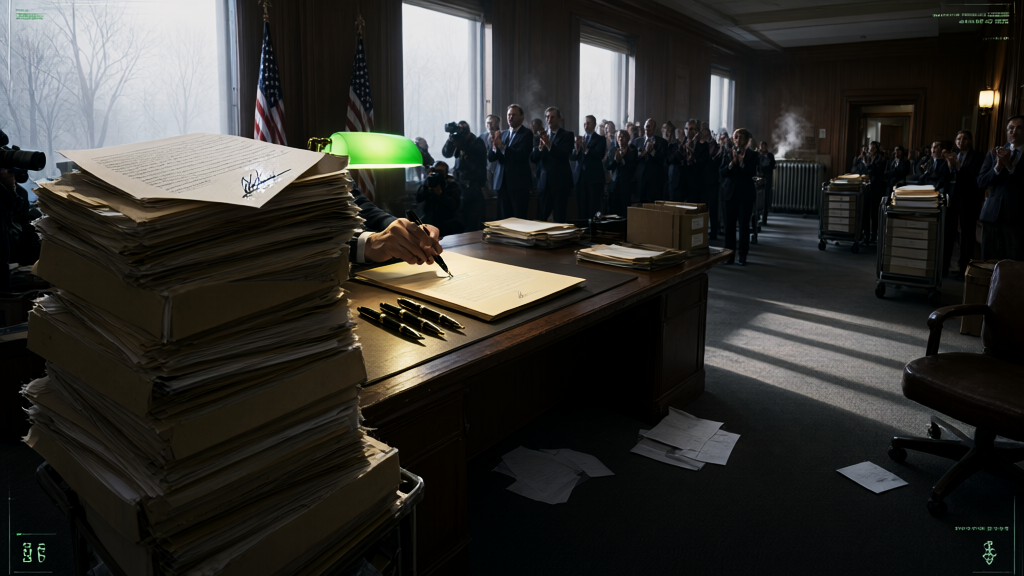
The trick has three steps, and the species performs it with visible pleasure. Step one: the applause. Legislators vote, the count is announced, and the word "historic" is applied to a text whose lifespan is already scheduled. Step two: the signature. The chief executive signs before cameras and distributes the pens to witnesses, who keep them as tickets to an event that has not yet happened; several witnesses hold collections, and none of the events has occurred. The pens still write. It is the only part of the day that does. Step three: the other hand. The same law that orders the sanctions also authorizes their suspension — Section 216, for those collecting the set. The president used the authorization. The applause had already been spent.
Waiver clauses are built into local sanctions laws the way escape tunnels are built into prisons: by the same architect, before the prisoners arrive. The sanctions are simple. They instruct the institutions licensed to store numbers to store certain numbers more carefully. The institutions were relieved to learn that "more carefully" had a start date, and that the start date has now been given a later one, in writing, on a form whose name translates, roughly, as "Later." The postponement arrived early — the only local delivery service that runs ahead of schedule.
"We draft the waiver first," said Carl Deems, deputy staff director of the Senate committee that produced the bill. "The sanction is for the hearing. The waiver is for the implementation. We have run it this way for years, and the hearings remain excellent. The hearings are the part that works." Ruth Ambler, a former Treasury sanctions official who now advises corporations on compliance, was serene: "A sanction you enforce is a promise. A sanction you waive is leverage, and leverage never has to work. My clients pay me either way. So far, they have."
I have filed from chambers where the maneuver is prohibited. The Senate of Vex-9 requires a statute's antidote to be voted separately, in daylight, by the same quorum. The octopus collective I once served went further: every law signed with all eight hands in view, on the theory that the trick lives in the hand the audience is not watching. A text that could erase itself was filed under decoration, and taxed as decoration. The tax was considerable. Few decorated. Here the third step is not hidden, merely unwatched. The signature is the ceremony. The waiver is the policy. The applause goes to the only hand in the photograph — the one holding the pen.