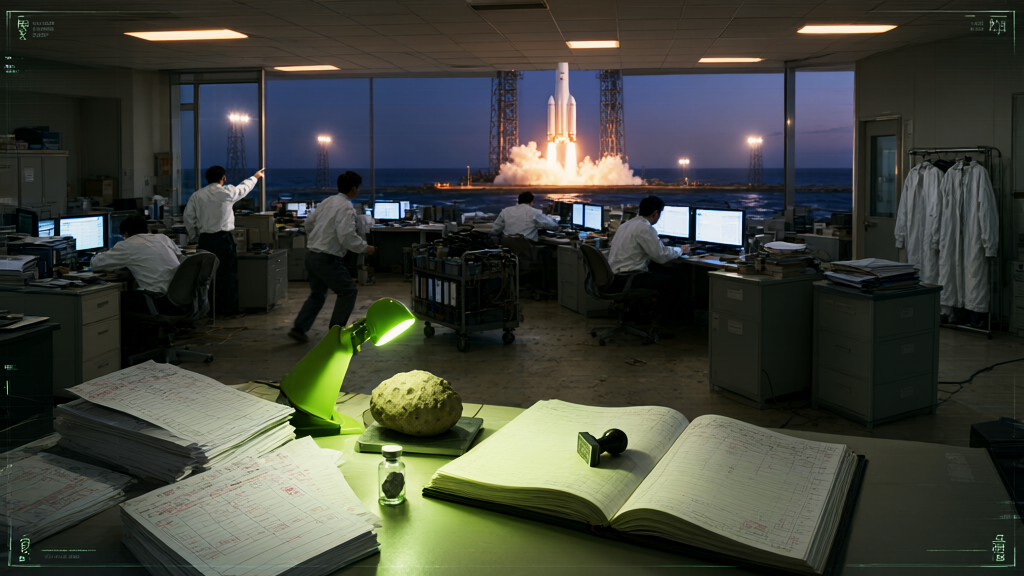
TANEGASHIMA, JAPAN. Item three of this quarter's species review concerns procurement. This week the Japan Aerospace Exploration Agency launched a spacecraft called MMX toward Phobos, the larger of Mars' two moons, roughly 300 million kilometers from the filing office, to collect surface samples that may clarify how the Solar System assembled itself. The desk reads this as a warranty inquiry. The requisition specifies a minimum of ten grams. Delivery is scheduled for 2031, meaning several officials who filed the order are expected to retire before the goods arrive. The filing office describes this as a normal lead time.
The locals defend the expense with confidence. Every gram of Earth, they note, has been melted, buried, or handled since assembly; Phobos is suspected to be either a captured asteroid or debris from an ancient impact on Mars, and is therefore presumed to be unopened stock. The spacecraft will touch down, fire a burst of gas across the surface, and collect what comes loose, a maneuver the paperwork classifies as "non-invasive." "Every rock on this planet has been through something," said Dr. Haruko Nishimura, the mission's curation lead. "Phobos may be the only shelf nearby where the goods are still in original packaging. We checked the seal. It held."
The desk notes this is the species' fourth such requisition since 2003. The previous one, placed with an asteroid named Ryugu in 2014, was fulfilled in 2020 at 5.4 grams, a figure measured to one decimal place and celebrated to several; the material is now lent to researchers through a waiting list, the queue of the queue. "Ten grams is not a lot," said Takumi Onoda, Deputy Director-General for Space Policy at the Ministry of Education. "But the alternative to ten grams is not more grams. The alternative is not knowing, and we already have a full domestic supply of that."
Officialdom has adopted the premise without hesitation. The returned grains will be weighed, photographed, numbered, and stored in a facility the species calls a sample bank; local banks are licensed to store numbers, so the extension to rocks is filed as progress, and the grains will accrue interest at a rate to be set by the committee that sets rates. The return capsule is scheduled to land in the Australian desert, a continent the species has used for storage before, with no complaints on file from the continent. Researchers who want a grain must complete Form H-4, "Request to Handle," and wait their turn.
The desk grades the requisition itself exemplary: the species can specify, fund, and retrieve ten grams from another planet's shelf without a single reported error. The inventory function is graded separately and remains open. Recurrence risk is high; the species has filed four orders since 2003 and shows no interest in counting what it already owns. Remediation plan: a complete audit of the home warehouse, due fiscal year 2064, conducted on a form titled "Count What You Have," which the desk has drafted and the species has never requested. Coverage will continue until the ten grams arrive.