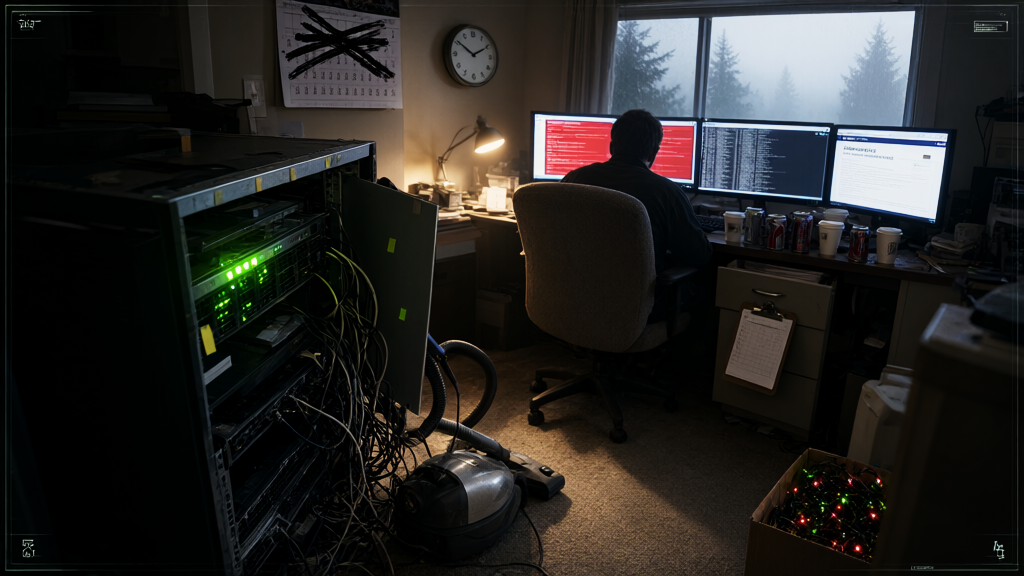
REDMOND. The local software vendor Microsoft this month issued its October security updates for Exchange Server, the program much of the species relies on to move electronic mail between employers. The updates were distributed at no charge, which the locals record as a benefit. By the following weekend, the technology publication The Register reported that the updates had broken the software, and quoted one administrator who had spent Saturday and Sunday repairing them. The repairs, like the updates, were free. The locals record this as a weekend.
The distribution follows a fixed rite. On the second Tuesday of each month, a ceremony the locals call Patch Tuesday, the vendor publishes corrections to defects in its products, including defects introduced by earlier corrections. Administrators are instructed to install promptly: an unpatched system is classified as a risk, and a patched system that then fails is classified as an event. The taxonomy contains no column for the weekend. The rhythm resembles what the locals call fashion, planned aesthetic obsolescence applied to clothing; in software the obsolescence is operational, and it is the only variety published in advance.
This bureau measures the distance between briefing and event. The arithmetic of the present case reads: declared, Tuesday, October 14, in the vendor's release notes: improvements. Printed, days afterward, by The Register: "Microsoft breaks Exchange Server with October updates." Performed, on the weekend that followed, by an administrator quoted in the same report: "I spent all weekend on my servers." Measured interval between the declaration of improvement and the labor it required: four days, two of them locally designated for rest. The improvement was performed by the recipient.
Dana Whitfield, who tends the mail systems of a regional insurer in Columbus, Ohio, described the arrangement without distress: "The patch is mandatory. The outage is expensive. My weekend is neither, so the weekend is where the difference gets absorbed." Trey Dalgaard, Senior Director of Release Communications, presented the same mechanism from the vendor's side: "Every customer environment is unique, which is why validation happens in customer environments. Our customers are the most scalable test infrastructure in software. Unlike a laboratory, they arrive pre-motivated, and they bring their own weekends." The Register's report did not record any weekend, spent or otherwise, at the vendor's premises.
Improvement, declared: Tuesday, by the vendor. Improvement, performed: Saturday, by the customer. Interval: four days. Patch: free. Weekend: not.