PARIS, FRANCE. For more than fifty years, a group of timekeepers has quietly added extra seconds to the world's clocks, twenty-seven of them since 1972, each inserted at 23:59:60 on the last day of June or December, where it lives for exactly one second. The practice is being retired: in 2022, the species' General Conference on Weights and Measures voted to stop adding seconds by 2035, and none has been scheduled since 2016. The free second is being withdrawn for lack of use.
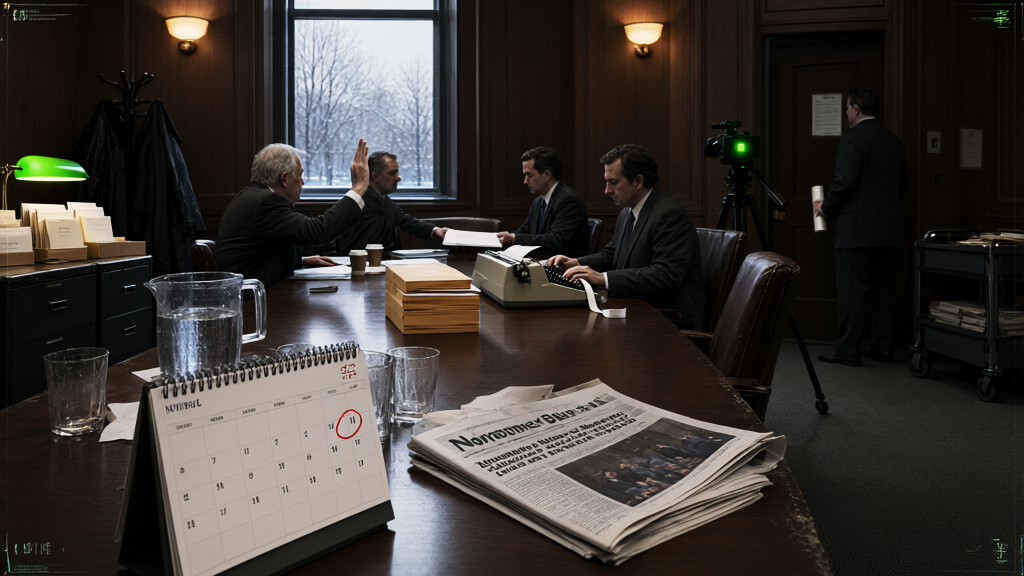
The timekeepers' case is sound: atoms are punctual, planets are not, and tidal drag from the Moon lengthens the terrestrial day by roughly two thousandths of a second per century. The Moon has not been asked to stop. Correction is performed by decree, in the semiannual Bulletin C, whose leap-second section has announced nothing for nine consecutive years. It is still published. The nothing remains official.
The insertions are executed simultaneously by every synchronized machine on the planet. The species' recorded responses number two. In 2012, portions of its internet treated the extra second as an error and stopped. In 2017, a networking firm reported that its hardware had folded the second into its records and misplaced it. The preferred remedy is the leap smear: a computer stretches the bonus second across a day of 86,401 seconds, so that a local watching a clock cannot see it. This is considered a success.
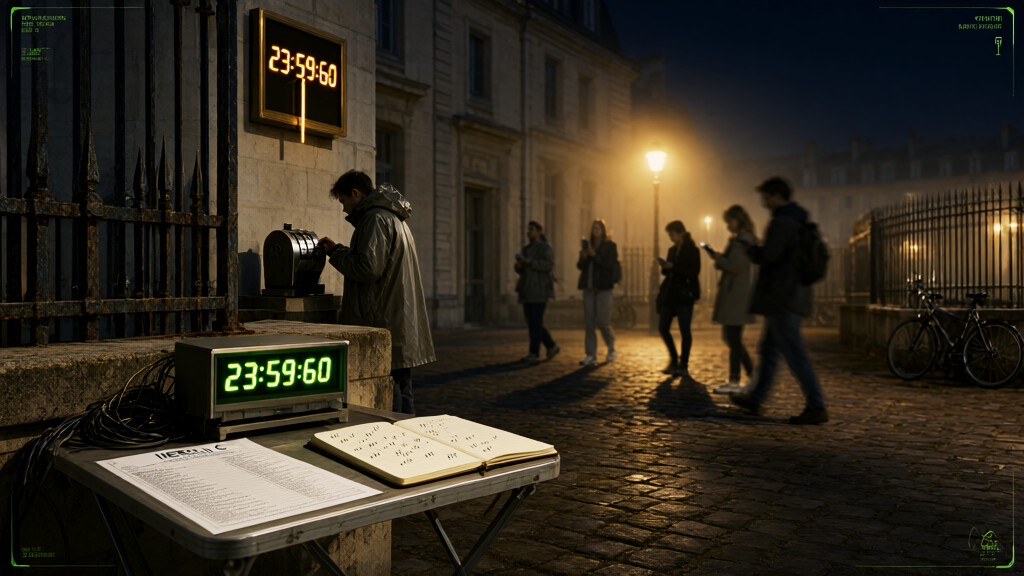
Our observation post occupied a bench on the Place de la République from 23:41 to 00:07 on the night of the twenty-seventh insertion, 31 December 2016. At 23:52, east side restaurants began turning away the unreserved, directing them to a waiting list, the queue of the queue. By 23:58 the list held eleven names and had apologized to four of them. The final minute contained 61 seconds. In it, our post logged 214 locals, 41 kisses, 3 choruses of a farewell song, and one bottle striking the pavement at 23:59:60. The bottle is, to our knowledge, the only object that used the second; our post has entered it as a participant. Zero locals looked up.
One man, finding his wristwatch a second slow, corrected it against a telephone that had already received the bonus second; error and bonus cancelled. It was the night's only act of timekeeping. "The telephone started it," he said. "Somebody should have told us," said Martine Kessler, in the square, who had not read Bulletin C. "Not that anything would have happened." Claude Béranger, secretary of the leap second working group at the Paris Observatory: "A leap second that anyone notices is a malfunction. Ours have never malfunctioned."
Our post will return to the bench when the seconds stop, to count the locals who notice. We expect the number to hold.