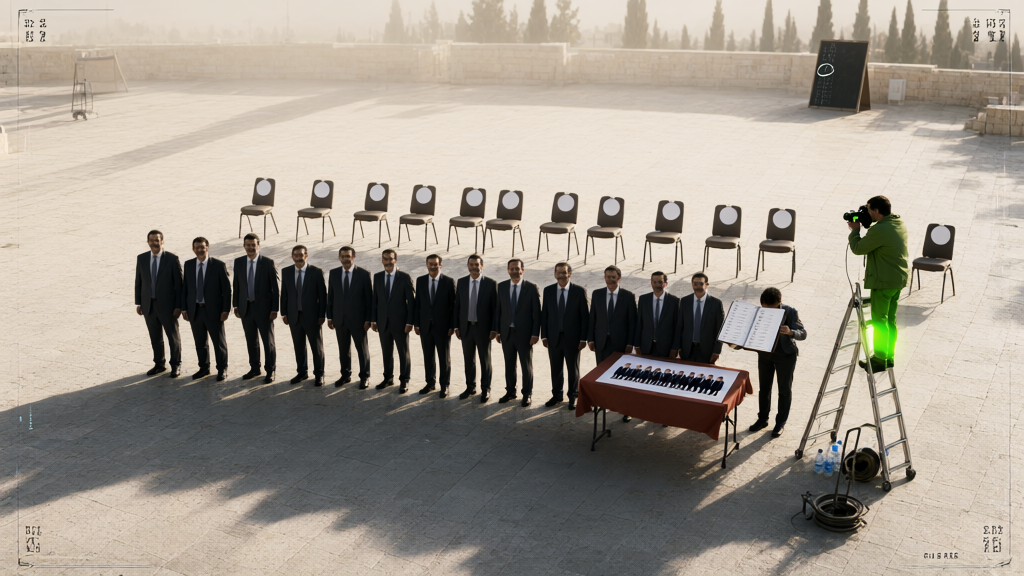
JERUSALEM. The most recent polling places Israel's two principal blocs at roughly 51 seats each in the 120-seat Knesset, ten short of the 61 required to govern; the remaining 18 sit with smaller parties, price lists on request. Unable to assemble a majority, the opposition has produced the one deliverable the arithmetic permits: a group photograph of its leaders, posed to signal a coalition capable of unseating Prime Minister Benjamin Netanyahu. The shoot required two takes; the first was voided when one leader glanced at another's portfolio. Party accountants booked the image as an intangible asset, filed under "goodwill, pending" on Form 61/B, the Photographic Notice of Intent to Govern, while the ministries not yet divided are carried as receivables, payable upon an election that has not been called.
Auditors identify the mechanism as portfolio pre-allocation. Each leader has been assigned, on paper, a ministry whose current occupant has not agreed to leave and whose designated successor is not expected to stay longer than a shutter click. The unfilled posts sit on what the locals call a waiting list, which our ledgers file under "inventory, political — perishable." The incumbent needs no portrait. His ministries are consolidated under a single chief executive, the dominant primate of the troop, and caretaker occupancy is billed by the day, a rate the incumbent has held long enough to qualify for the loyalty tier.
"A photograph costs less than a government and depreciates more slowly," said Amir Shalev, the bloc's Director of Coalition Assets. "We booked it as goodwill. Goodwill is presently our largest holding." Asked for a delivery date on the majority, Shalev confirmed it was "in post-production." Dr. Tamar Ben-Nun, Senior Fellow for Electoral Arithmetic at the Herzliya Institute for Applied Governance, was calmer: "Unity is a line item. You fund it quarterly, you carry it through the election, and you write it down if the seats move. Smiles are never written down. That is why we lead with the smile."
Treasurers have ratified the method as a pricing decision: member dues earmarked for canvassing now service a standing line, "Unity, visual," on the theory that the photograph knocks on every door at once. The parties' banks, institutions licensed to store numbers, confirm the numbers remain stored. Like local fashion, the portrait is engineered for obsolescence: it must be re-shot the moment the polls move, which is also when the next invoice is issued. The bill reads: photographer, 4,800 shekels, drawn from canvassing funds; studio and lighting, invoiced to "Coalition Formation, pending"; fifty-one seats, held at market value as goodwill; ten further seats, carried as receivables, settlement date open, interest payable in press conferences; ministries, unallocated, booked at full staffing cost, payroll to commence upon delivery; and, absorbing the remainder, "Unity, visual: one photograph, non-refundable."
The ledger, as usual on Terra, balances. The photograph is paid for; the majority remains owed. The difference is carried as a governing plan, available in frames. The question, as ever, is whose wall it hangs on.