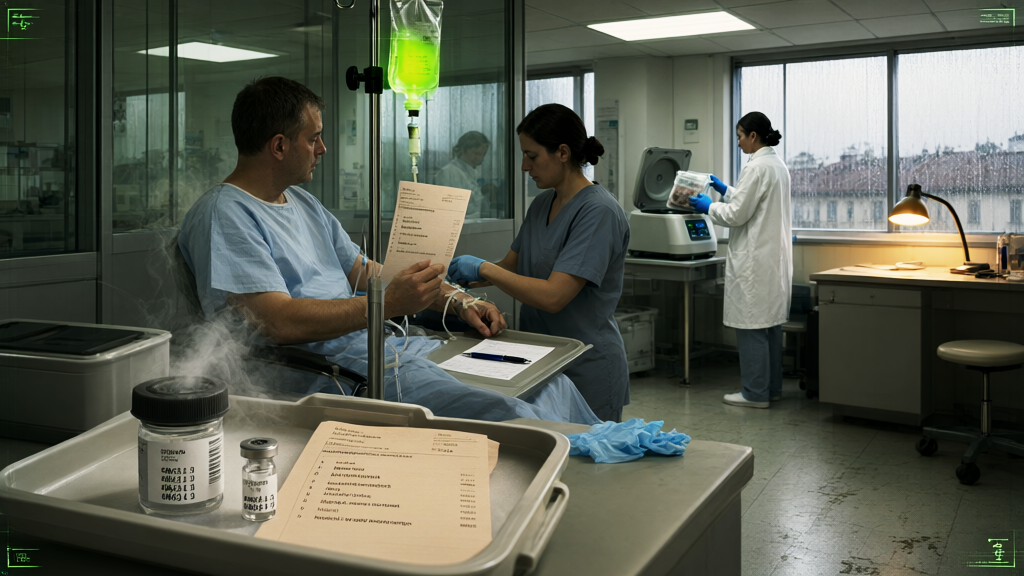
MILAN. The first therapeutic mRNA vaccine in recorded local history works against melanoma; the trial numbers are not in dispute. Each dose is built in six weeks from the tumor surgeons cut out of the patient it protects, which makes this the only supply chain on Terra that begins inside a paying customer, ends inside the same customer, and casts him as the freight. He attends every transaction. He appears on both sides of the receipt. He does not tip.
The mechanism itemizes cleanly. A laboratory sequences the removed tumor, selects up to 34 mutated proteins the patient's immune system failed to notice — a figure the Desk admires: somewhere, a machine counted exactly what the customer missed — and prints the instructions in mRNA. Six weeks after the operation, the tumor returns to its former owner as injections, alongside an existing antibody drug. In the phase 2b trial of 157 patients, the combination cut the risk of recurrence or death by 44 percent versus the antibody alone. Moderna and Merck co-developed it, which in Desk terms means the invoice has two letterheads.
The defense writes itself, and the Desk has read it. Every dose is a bespoke product: one patient, one tumor, one six-week print run. Sequencing and machine time cost real numbers, the consent forms were signed, and the arrangement is marketed as personalized medicine, a term the Desk accepts literally. The medicine is personalized. So is the invoice.
"From the operating table it was one lump," said Dr. Gianluca Ferretti, a surgical oncologist who has harvested the raw material. "From the billing office it was two events. We invoice the departure. The factory invoices the return." "Captive raw material is priced at zero," said Marcus Peale, a pricing consultant retained by three hospital groups. "The patient cannot take his tumor to a competing refinery. It is the standard supplier discount, and it is generous, because the supplier is also compensated in survival."
Followed one step, the logic holds. A therapy grown from a patient's own tumor comes with a supplier who, should the disease return, can restock; the Desk has searched its files and found no second arrangement in which the warehouse, the shipment, and the reorder are the same mammal. The CEO of a health-economics consultancy, the dominant primate of a small troop, called this an aligned incentive. Nobody said "restocking event" on the record. The next cohort of donors is assembling. "Recruitment is not a problem," said one trial coordinator. "Every volunteer arrives pre-loaded."
Asked whether any of this is a moral failure, the Desk notes that it does not carry that line item. It is a pricing decision, and it itemizes as follows: one tumor, patient-supplied, payment to supplier, zero; surgery to extract it, invoiced to the supplier; pathology to grade it, invoiced to the supplier; six weeks of refinement, invoiced to the supplier's insurer; one dose returned to the supplier's arm, invoiced again; freight, both directions, internal, no charge, the cargo having traveled inside the payer. The covering line item reads "patient-specific biologic," which is accurate. The ledger, as usual, balances. The tumor entered as a donation and exited as revenue.