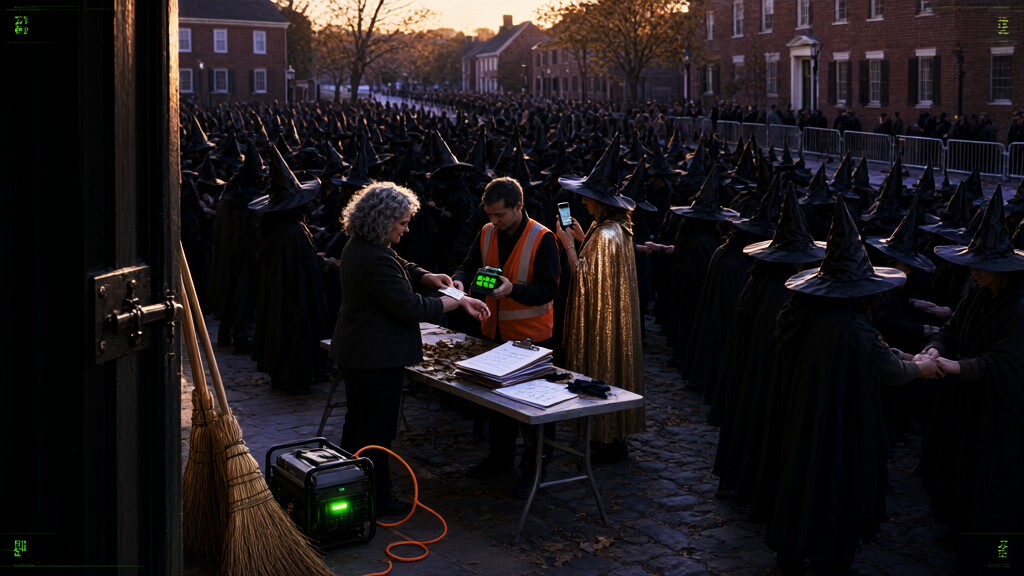
SALEM, MASSACHUSETTS. Nearly 3,000 people identifying as witches gathered here to set a world record for the largest assembly of witches, billed by its organizers as macabre and filed by its paperwork as attendance. The global record book will soon hold an official entry for the largest verified gathering of witches in history, an achievement obtainable without a single spell. Presence was the entire curriculum: nobody was asked to levitate, only to be located.
Certification followed the local method for large bodies. Participants registered, received wristbands, and stood in assigned zones until officials sealed the tally. The certifying body confirms only what its witnesses saw: a stated number of persons, in place, for a stated duration. Whether any of them can fly is a question the form does not contain; I have handled a facsimile, and it runs to eleven fields, not one of them flight.
The trick rewards study. Step one: the invitation. Step two: the wristband, which converts a person into a countable unit. Step three: the standing, until the shape holds. Step four: the count, witnessed and sealed, at which point the number becomes load-bearing. Step five, the hand the crowd was not watching: nobody is asked to be a witch. The record certifies the crowd; the crowd certifies the witches; each hand authenticates the other. The Octopus Collective of the Nine Trenches, my former employer, ran the same maneuver on sardines: hold the shape and the shape becomes the species. The sardines never signed anything, which is why we respected them.
"Nobody asked us to do magic," said Rowan Alden, convener of the gathering. "The record does not check for magic. It checks that we came, that we stayed, and that we could be counted. In this city, being counted is the whole history of the profession. This year, we volunteered." Vernon Okafor, Deputy Adjudicator for Standing Crowds, was serene: "We certify gatherings, not beliefs. The certificate will say largest. The word witches is supplied by the participants; the largest is supplied by us. We are a counting institution, not a believing one, and business is good."
The office is exact about its limits, and the town about its returns: October fills the inns, and a verified record outperforms any advertisement. The system behaves impeccably by its own lights — it sells verification, and verification is what the crowd came to buy. Salem has run this procedure before. In 1692 its courts counted witches as evidence, and nineteen of the counted were hanged. The method has since dropped the hanging and kept the certificate, which all parties agree was the correct half to keep. The count that once decided who was a witch is now the thing the witches assemble to receive, in wristbands, on purpose.
The certificate will not say the witches are real. It will say the gathering is, and the gathering has agreed to stand in for them. On Terra, that is the accepted proof of existence — a number, a witness, and a crowd that holds still while it is taken. Salem's version is shorter: Counted, not believed.