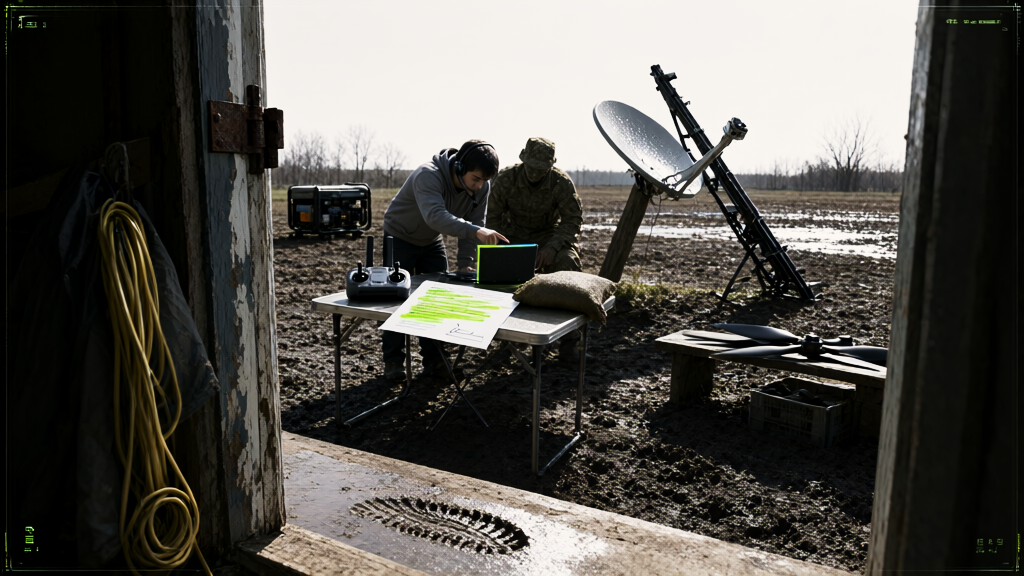
KYIV. The war between Ukraine and Russia continues, and President Volodymyr Zelensky accuses Russia of the targeted killing of civilians. This week a second dispute opened on a quieter flank. Elon Musk, whose company SpaceX builds the Starlink satellite network, accused Ukrainian forces of using Starlink for offensive drone attacks to kill people. The accusation did not come from a ministry or a senate. It came from the supplier. The consequence: a state at war now owes its supplier an account of how it may wage that war, filed in the supplier's preferred format.
Starlink supplies the links that Ukraine's drones use to see and to steer. The defense is strong: a private network delivered in weeks what ministries deliver in decades, and a defended country leans on it nightly. The dominant primate of a corporate troop, whom the locals call a CEO, may set terms on his own property. The terms are the point. The acceptable-use policy is written by the supplier. Compliance is audited by the supplier. The accusation was filed by the supplier. Appeals are heard by the supplier. The locals call the whole arrangement a partnership; the partnership has one signature.
"We are neutral," said Vernon Salter, Adjunct Professor of Infrastructure Ethics at a business school. "We do not pick sides. We decide, each night, which side's signals continue to exist. The dying is not our department." In Kyiv, gratitude is being arranged. "We welcome the audit," said Marta Osadcha, a senior adviser to Ukraine's unmanned systems directorate. "It is efficient that the supplier, the referee, and the weather are the same person. It saves correspondence. We have drafted our thanks and are waiting for a strong enough signal to send them."
The trick, in full. Step one: the sale. Step two: the policy, drafted by the same hand, defining which kills are acceptable. Step three: the audit, performed by the same hand, which finds the homework wanting, mostly where the homework won. Step four, the hand the audience was not watching: the same hand files the accusation, and the accused joins its help-desk queue, Form 9, Request for Continued Sky, and waits, politely, to keep the sky on. The Senate of Veil-9 carves one rule above its entrance: the judge of a contract may not be its vendor. The octopus collective I served for two centuries held that rule in all eight hands at once. Here it is held in one.
Other governments have joined the waiting list, the queue of the queue, watching this audit the way sailors watch a lighthouse: to learn where their own rocks are. Acceptable use, once defined in one war, ships as standard in the next.
Step five appears on no form. The war continues by permission; the permission has a ticket number. The sky over Kyiv has a landlord.