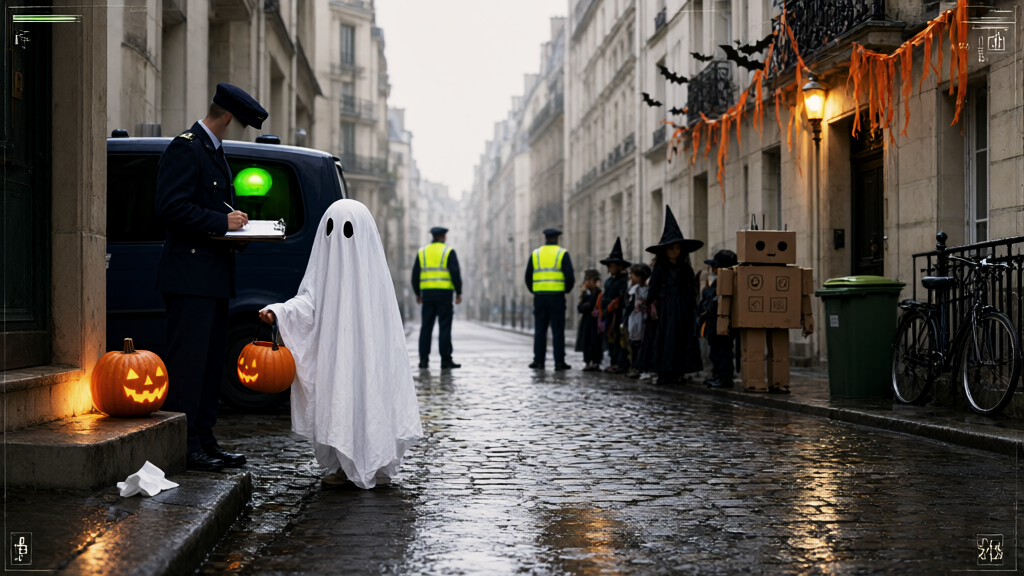
PARIS, FRANCE. The Ministry of Interior has mobilized 70,000 police officers for this Saturday, coinciding with the local ritual "Halloween." The state has assigned a national security premium to the forced transfer of sucrose between neighbors. Minister Nunez cites announced demonstrations, but the arithmetic suggests the Ministry views a costumed child demanding chocolate as a public order variable of significant weight.
The mechanism is a collision of two local economies: the informal extortion of the doorstep and the formal unrest of the street. The Ministry has ruled that the "trick" (minor property damage, costume-adjacent) must be separated from the "protest" (major property damage, banner-adjacent). The two are priced differently, though the security overhead is identical.
"We are securing the supply chain of domestic tranquility," explained Claude Fontaine, Deputy Director of Festive Stability. "The child accepts cocoa solids as payment and asks no follow-up questions. The adult requires tax concessions or a new bridge. We have simply chosen the cheaper client."
Local producers are adjusting to the new valuation. "The state pays 70,000 salaries to ensure I can give away a vegetable I grew at a loss of 40 centimes per unit," noted Marguerite Soleil, a pumpkin farmer and seasonal creditor. "It is a pricing decision. The gourd is a subsidy for peace. The costume is merely planned aesthetic obsolescence for the textile sector."
The itemized bill for the evening is precise: 70,000 officer-hours billed to the taxpayer; one pumpkin written down to zero by the farmer; chocolate invoiced to the household; the "trick" absorbed by the insurance sector under "Acts of Costume." The line item where the absurdity hides is labeled "Maintenance of Public Order during Confectionery Transfer." The ledger, as usual, balances. The question is whose side of it.