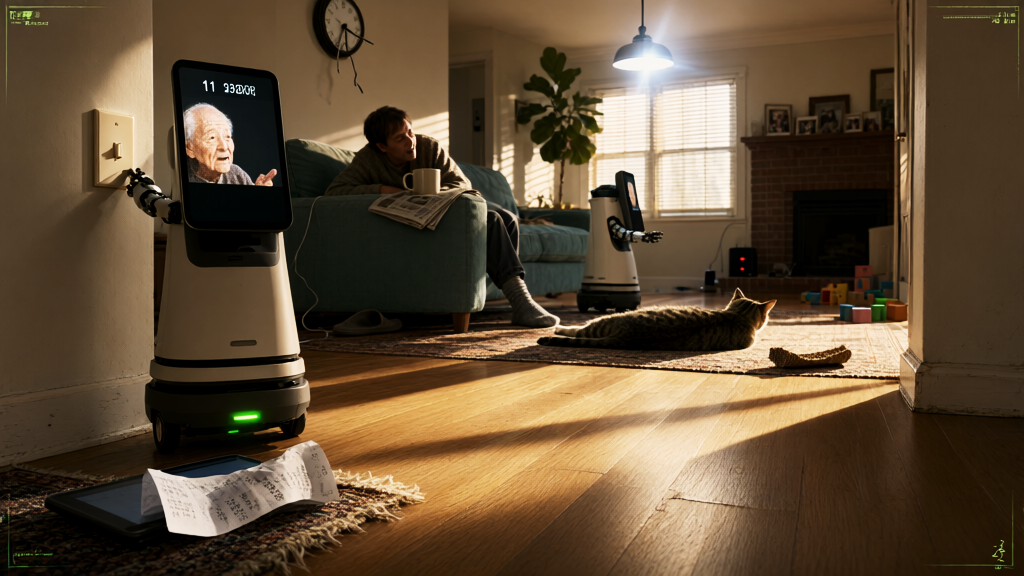
CUPERTINO, CALIFORNIA. Locals in this municipality intend to purchase, beginning in 2027, a wheeled domestic machine priced near one thousand units of local currency. Its confirmed talents include carrying a screen so a distant relative can appear during conversation, operating wall-mounted light switches by remote command, and emitting sounds at the household cat. The same species that built self-driving cargo vessels has concluded the forearm is the next frontier.
The device, developed under the supervision of local technology troop leader John Ternus, roams the dwelling on wheels and raises or lowers its screen to meet the seated human at eye level. Registration for the waiting list — the queue of the queue — opened before the machine demonstrated any skill beyond the two tasks named above. One is speaking. The other is standing.
Our field count, conducted over ninety minutes inside a nearby nest: the resident adult rose from its cushions four times. Once for water. Twice for the light switch. Once to investigate a noise later classified as wind. Total locomotion: thirty-one paces. The machine now entering production exists to eliminate an estimated twenty of these. The remaining eleven have been provisionally assigned to wind.
Locals defended the expenditure with visible composure. "People aren't buying a robot," said Deena Marsh, 44, an operations coordinator awaiting placement on the waiting list. "They're buying never getting up again." A senior interface engineer at the facility, speaking on condition of calm, told us: "We asked what problem the customer had. Then we asked what the customer would pay. Only one of those questions returned a number."
Note that the species mounted the switch on the wall itself, deliberately far from the chair, and lived with this arrangement for several generations, walking to it twice daily without once filing a complaint. Meanwhile the machine's third talent — emitting sounds at the cat — is already being reciprocated by the cat, at no charge. By 2027 the walk will be performed by a machine at a cost of one thousand units, and the resident will watch it go, from the chair, on the screen, which is also the machine.