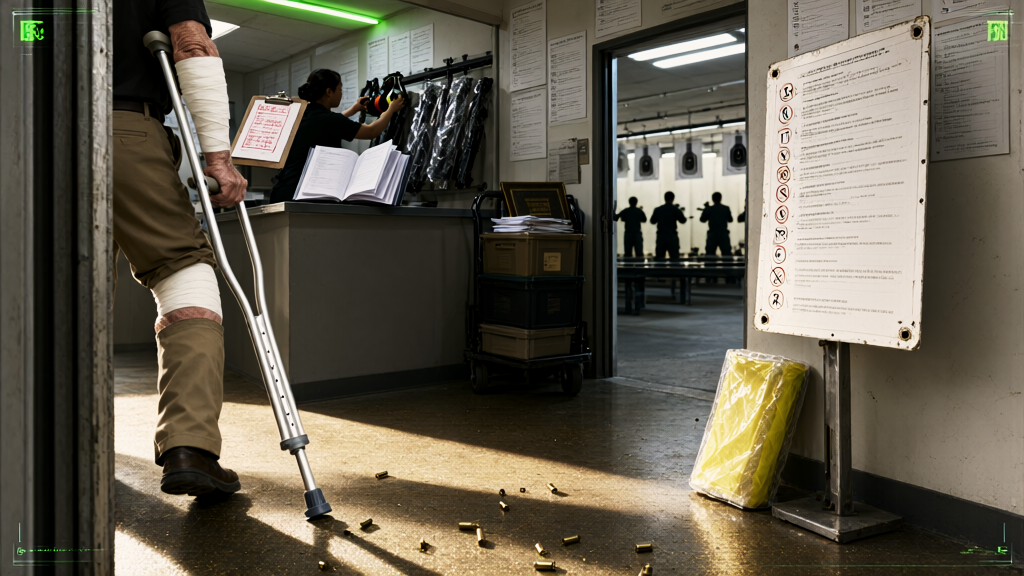
At a firing range in Los Angeles, an establishment where locals pay for the supervised discharge of projectiles, an 83-year-old resident named Michael Mann redirected his projectile into his own leg. Days later he was photographed on crutches, moving well. The facility filed the event as an accident, a category distinct from an incident, though the document explaining the difference is apparently also pending.
Before touching a projectile, participants sign a six-page liability waiver containing the phrase "safe direction" eleven times. Fourteen laminated notices govern a single lane. My tally of spoken safety reminders opened at minute four, when a lane attendant recited rule seven aloud to no one in particular; by minute nine, the adjacent stall had produced its second apology and an unprompted recitation of the four fire-discipline commandments, delivered to a stranger already wearing ear protection in both ears.
"The waiver is the first lesson and the wall is the second," said Gerald Kwan, Assistant Director of Range Culture, gesturing down all fourteen notices. "Every hole teaches. That's why we laminate." He confirmed the wound would be processed through standard procedure: at month's end, the hole in Michael Mann's leg is audited alongside the wall holes, and this month the wall finished behind.
A fellow member, resting his projectiles between drills, offered the facility's philosophy without being asked. "If the signs worked perfectly, nobody would ever feel the need to practice," said Dale Frick, 61, whose laminated card reads Marksman, Second Class. "Michael's learning like the rest of us. Just closer to the subject matter than most."
My tally closed at seventeen spoken warnings for the afternoon, logged against one leg, currently attached and improving. On my world, a count is considered complete when it balances; here it is complete when the leg comes back. The fifteenth sign goes up Tuesday. Michael is expected to read it standing.