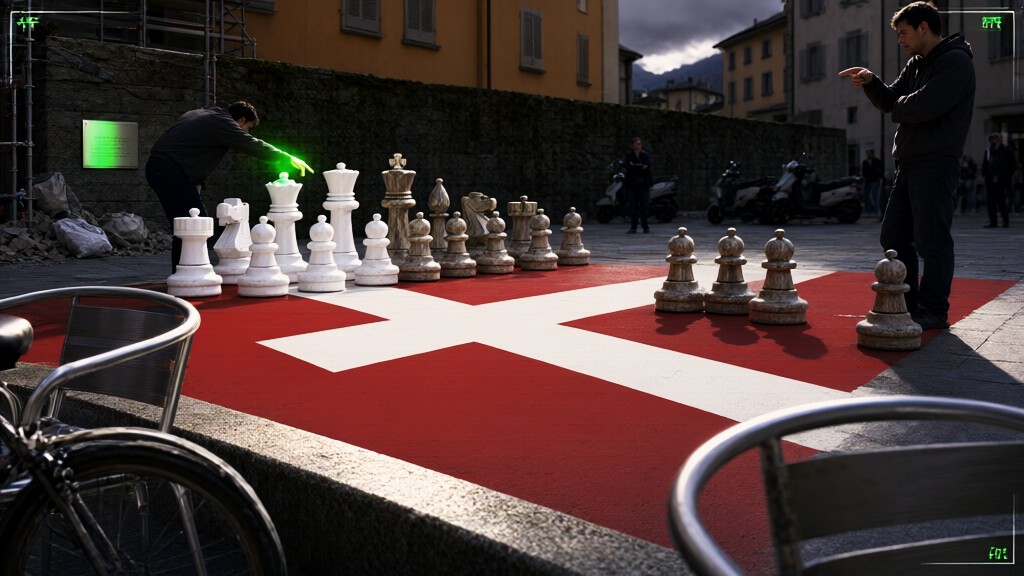
BELLINZONA, SWITZERLAND. The municipality has repainted its principal public chessboard in the colors of the national flag: a red ground with a white cross advancing through the centre. Chess requires an alternating pattern of light and dark squares; the new surface offers one shade and a symbol, so play now opens with a negotiation the rulebook does not anticipate. Players must first agree which red is the light square. There is one red.
Field log, minute zero: seven players assembled, several wearing garments newly retired into the local custom called fashion, in which clothing is discarded while still functional. Minute nine: the group produced its first apology, addressed to no one in particular. Minute seventeen: the apology was answered, also by no one in particular. Minute twenty-two: a child asked where black begins. Her grandfather pointed at the white cross and said, "Black begins wherever they leave room." The repaint consumed fourteen litres of red enamel, one municipal afternoon, and the central eight squares.
"Before, half the board was dark," said Renzo Bottelli, president of the civic beautification committee. "Now the whole square belongs to everyone. No one can claim the dark corner anymore." Play has adapted around him. Pieces standing on the white arms of the cross may not be captured, because removing them is classified as vandalism, and a piece that reaches the cross is said to have gone home. The town council has reviewed the outcome, declared it a success, and placed the playground hopscotch grid on the agenda for the same treatment. A waiting list already exists for the nearby bench, from which the board is most comfortably admired.
"You stop looking for the black pieces," a spectator told us, a retired customs officer named Aldo Ferrata, in the tone one uses for the weather. "You look where they are not. It works."
Minute fifty-eight: zero completed games, eleven photographs taken, three disputes settled by coin toss, all three decided in favor of whoever touched the cross first. The photographs show a flag. Our census of the board records sixty-four squares declared, thirty-two visible, zero dark. On our world the count is the government. Here the count is decoration, and it plays white.