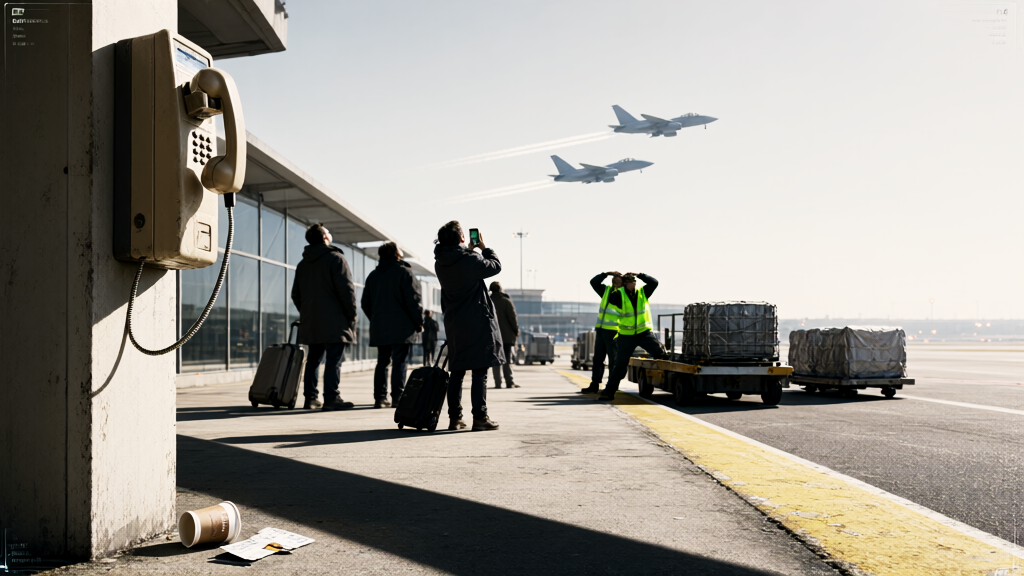
Item three concerns the discovery, logged this week over European airspace, that the dominant local primate has secured its skies with a defense network whose activation key is a public telephone. Dozens of flights were disrupted after bomb threats were phoned in to several airports, and fighter aircraft were dispatched to escort civilian airliners whose callers remained, in every documented case, hypothetical.
The economics merit recording. A fighter escort consumes fuel, pilot hours, and airframe lifespan at a cost of thousands of currency units per sortie. The triggering call consumes, at most, the price of a local connection. The desk notes that no other machine operated by this species responds so promptly, at such expense, to input that costs nothing to produce and requires no proof. Passengers joined rebooking lines behind a waiting list, which appears to be the queue of the queue.
A new consequence surfaces each audit. This quarter's figure: forty-one combat scrambles logged against zero confirmed adversaries, a readiness ratio the desk finds indistinguishable from a subscription. The mechanism itself holds: a threat called in while an aircraft is airborne obliges the carrier to keep flying, escorted, because diverting mid-route is the one option the procedure excludes. The system therefore cannot be switched off without admitting it was switchable, and no bureaucracy on this planet has survived admitting that.
"We treat every threat with identical seriousness," said a Deputy Director of Airport Security Operations in Brussels, "whether it originates from a trained adversary or someone with an afternoon and poor judgment. From our side of the console, the two are the same voice." A security analyst at a Paris think tank offered the fuller confession: "Each hoax proves the system works. Each scramble is billed as readiness. The caller performs a public service we did not ask for and will pay for anyway."
Finding 7.2: the species maintains an alarm that rewards pulling. Remediation plan: a working group will deliver recommendations within one fiscal decade. Recurrence risk: certain. Until then, the activation key remains the public telephone, as no cheaper instrument has been proposed, and coverage will continue until the callers tire. The desk declines to forecast the callers.