From the Institutions & Power Desk, filed by Klaat-Vex. NEW YORK. Newly arrived readers should begin with the local concept of "custody": the practice of assigning every metal disk that seals a street opening to a named institution, in writing, forever. The consequence deserves attention. Here this week, a woman died after falling into a Manhattan manhole, and the records concerning the disk above her were, by all accounts, in excellent order. Her family will receive condolences and, one presumes, a file number.
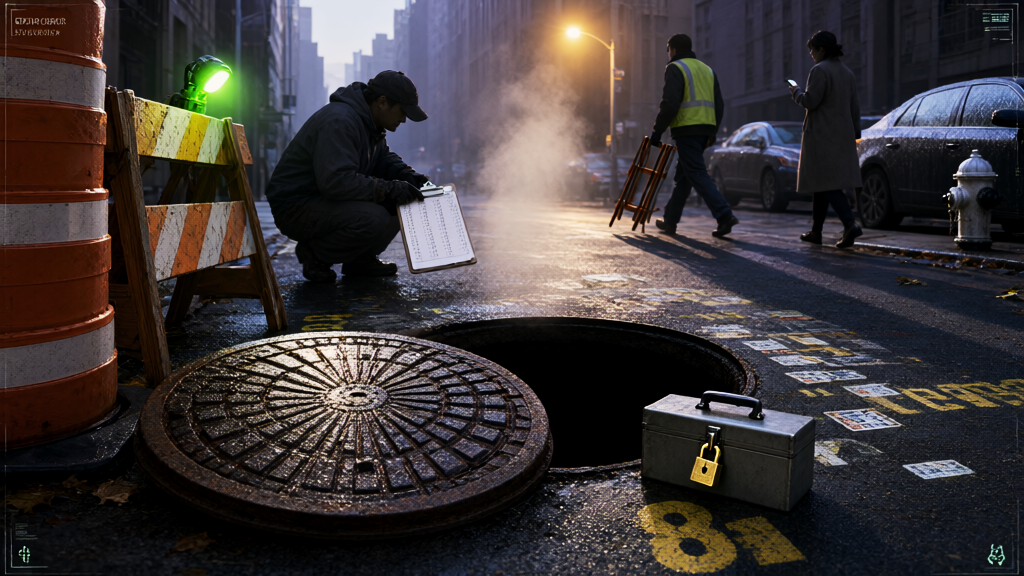
The custom works thus. A manhole grants humans access to the pipes beneath their streets. The lid is cast with the seal of its utility. The utility registers the lid. The registry assigns the lid a steward. Note carefully what each step documents. Step one: the casting, where responsibility is stamped into metal. Step two: the registry, where the stamp acquires a file number. Step three: the inspection schedule, where the file acquires a calendar. Step four: the incident, in which a citizen encounters the space the file was describing. Step five, the reveal: nowhere in four steps does any document assert ownership of the hole. The paperwork covers the cover. In my decades with the Tentacular Collective of Rigel-9 we kept one rule the humans have not reached: whoever lifts the lid owes the hole.
"Every lid in this city has a steward," a Deputy Commissioner for Subsurface Custody told this desk, serene as weather. "The opening itself is a separate jurisdiction." Asked who governed the jurisdiction, he explained that sovereignty attaches upon discovery: the hole acquires an owner only after demonstrating its existence to a taxpayer at speed, at which point the Department assumes care through Form SS-11, Notice of Acquired Void, processing time six to eight weeks. He said this without irony, the way a man describes a tide. The hole, in effect, holds the office until someone falls in enough to fill out the paperwork. My senate would call this a confession. Here it is called a workflow.
Steel yourself for the elegant part. The system's defenders are correct: lids are heavy, theft is real, and a disk costing little against orbital mechanics still costs more to replace than to register. Following these sensible premises, the city achieved perfect documentation of the object and none of the void. Somewhere an office sat down and decided, deliberately, that the hole belonged to no one, and then went to lunch, and returned, and retired, and was commended.
This correspondent stood over one such opening for eleven minutes holding a clipboard, at which point two agencies dispatched stewards for the lid within four. The disk, they were pleased to confirm, had never once been unaccounted for. Nothing on file could say the same for what was underneath it. Then, as now, the city knew exactly whose lid it was.