KUALA LUMPUR — The claim under review, issued repeatedly by the government in Washington, states that American export controls keep advanced artificial intelligence chips out of China. We came to verify the claim. The claim verified instantly, then asked us to look behind it: the chips stay out. It is the computing that files through anyway, wearing nothing but a login.
CLAIM: United States restrictions prevent high-end AI chips from reaching China.
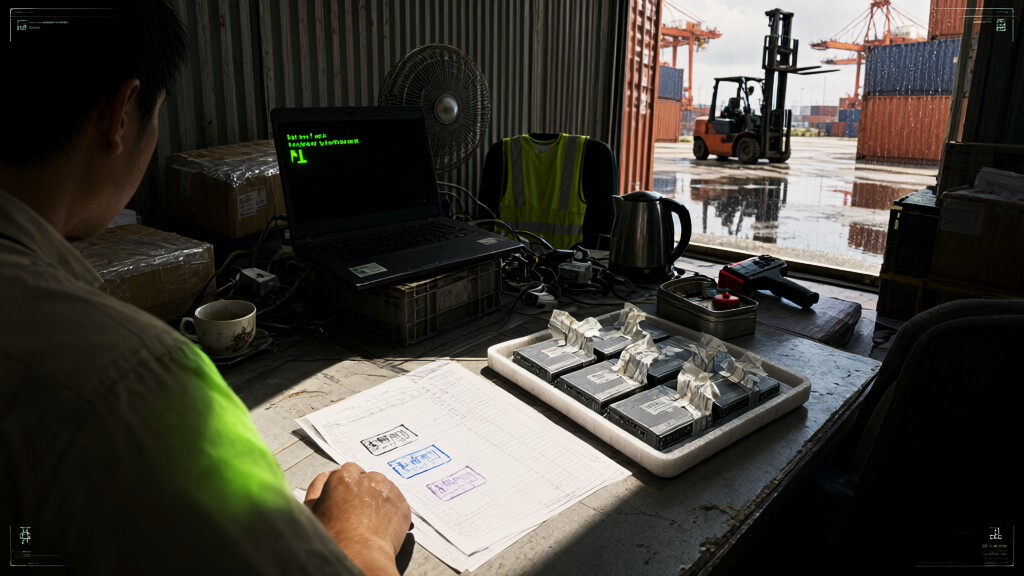
EVIDENCE: At rack 41 of a data facility outside Kuala Lumpur, our observation began at 09:00 local time. In two hours we logged 1,847 processing requests arriving from a customer address registered 4,100 kilometres to the north. At minute nine, the rack paused for cooling and produced, by our tally, its eleventh unremarked change of effective jurisdiction. By minute one hundred and twenty, the nineteenth. The chip moved 0 centimetres during the entire session; the work crossed the equivalent of four borders and one monsoon system without presenting a single document to anyone. The mechanism is ordinary to locals: operators buy the restricted machines, plug them in, and rent slices by the hour to anyone holding a password. Orders for the hardware itself sit on what locals call a waiting list — a queue for the queue.
"The chip has never left this room," said the facility's operations director, a calm man surrounded by forty-one humming cabinets. "What the renters do with the answers in other countries is, contractually, their weather." A Singapore-based compliance consultant whose firm certifies such facilities confirmed the division of labour: "We verify the hardware daily, and we do it very well. Where the thinking happens is not a field we are licensed to measure." Washington's response has been to draft new rules governing who may rent computing capacity and from which chair — the border migrating from a line drawn across terrain to a line drawn around a seated person typing, which is, we note, the exact posture of every human currently reading this.
For scale: the processor in rack 41 is the size of a kitchen tile, costs more than the vehicle our field team abandoned in Johor, and spent Tuesday afternoon quietly deciding how fast another civilisation gets to think. Customs inspected the crate it arrived in. Nothing inspected the quadrillion departures that followed, because arithmetic does not have a crate, a lane, or, on any paperwork we could find, a nationality. The facility's fire-safety log lists more inspections per month than the workloads receive per year.
Our departing tally stands at one chip, zero border crossings, nineteen jurisdiction changes, and several quadrillion exported operations. On our world, populations are managed by count alone, so we applied the method and found a species that has solved containment entirely: it guards the animal and counts the offspring. The machines stayed. Everything they did left.
VERDICT: TECHNICALLY TRUE, IN THE WAY A FENCE IS TECHNICALLY COMPLETE WHEN THE RIVER CARRIES EVERYTHING ACROSS.