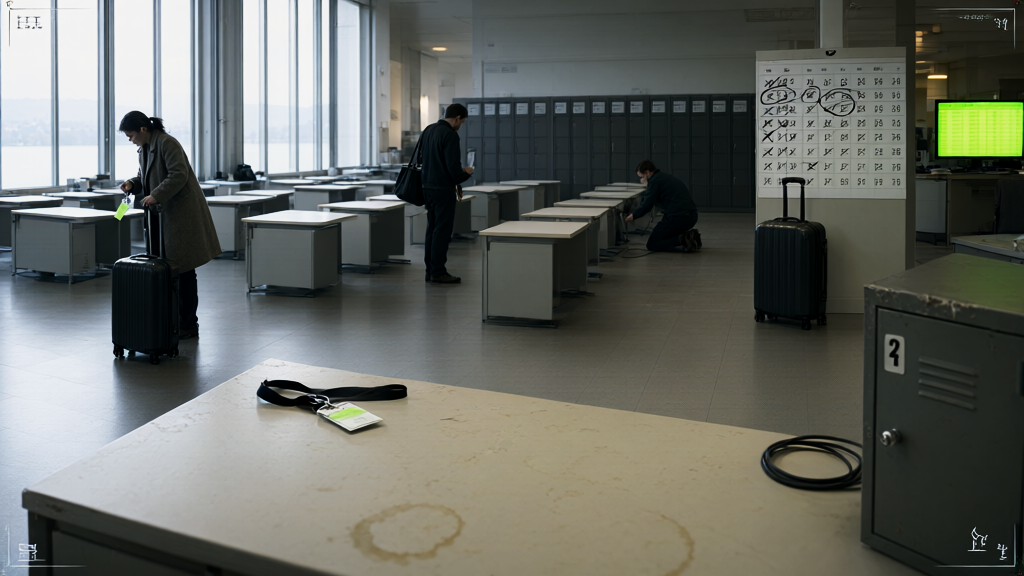
LUZERN, Switzerland. The canton of Luzern is consolidating about 30 administrative offices into one building with 1,200 workstations for roughly 2,000 cantonal employees, a model called hot desking. Under it the desk is not a place but a time slot; the late arrival inherits what the arithmetic of absence leaves: six tenths of a desk per head. The remaining four tenths are, in accounting terms, a rounding error with a spine.
In its own terms, the logic is sound: a desk costs money whether sat upon or not, and the species is never fully present, spread across holidays, illness and field work. Thirty leases on half-empty buildings were rent paid on air. The mechanism reconciling 2,000 bodies with 1,200 desks is a booking system; those who fail to reserve in time join a waiting list, in local usage a queue for the queue, with the same odds as everyone else and a better view of the procedure.
The arrangement has an invoice. Under internal cost accounting, each department pays rent for the workstations it occupies. Savings from the 30 retired leases are booked at once; the cost of sharing is booked nowhere, a line item the canton has priced at exactly nothing, which is the most competitive rate in the building. A bank is, per the glossary, an institution licensed to store numbers. The canton stores francs and leaves the minutes unbanked.
"I book my desk at five the evening before, from the train," said Sandra Wyss, a budget clerk in the cantonal finance department. "By 17:05 the window desks are gone. My stapler is in a locker on three, my nine o'clock meeting on five. I keep files in the car. The car, at least, is mine full time. I have started to think of the locker key as my salary."
"Every square meter must earn its keep," said Daniel Roth, chief executive of a Zurich consultancy, the dominant primate of a corporate troop that sells desk removal to desk owners. The canton is calmer. "The question was never where two thousand people will sit," said Reto Kaufmann, head of Cantonal Real Estate Services. "The question is how much sitting the taxpayer should fund. We set the price at six tenths of a desk per employee, and we consider that generous."
The Desk files the invoice. Line one: the taxpayer pays rent on one building. Line two: the departments pay internal rent per workstation occupied. Line three: the employee pays the difference between 2,000 and 1,200 in mornings, locker keys and files kept in cars. Line four: the 30 former landlords receive nothing, printed in green under the word savings. Line five: the 800 nonexistent desks, billed to no one, because a cost renamed flexibility is free. The ledger balances. It was drawn by the party holding the pencil, and what is never entered cannot be owed.